
Charlotte Logging Truck Accident Lawyer
Legally Reviewed by the Stewart Law Offices Content Team: Sep 19, 2026
Logging trucks are among the most dangerous vehicles on any road. When one of these massive rigs loses control, sheds its timber cargo, or rolls over on a Charlotte highway, the consequences for everyone nearby are often catastrophic. If you were injured in a collision with a logging truck in the Charlotte area, you need an attorney who understands both the unique physical dangers these vehicles present and the complex web of legal liability that comes with timber hauling operations.
 Stewart Law Offices represents people injured by logging trucks and other commercial vehicles throughout Charlotte and across North Carolina, and we are ready to go to work for you. Our team includes Elizabeth VonCannon, a licensed attorney in good standing with the North Carolina State Bar, who brings more than six years of dedicated experience advocating for people seriously injured in commercial vehicle collisions. Elizabeth gives every case personal attention, maintains close communication with her clients throughout the process, and approaches each matter with the patience and care that a serious injury claim demands. When you work with Stewart Law Offices, you will always know who is handling your case and where things stand.
We take all logging truck accident cases on a contingency-fee basis. You pay no attorney fees unless and until we recover compensation for you.
Why Logging Trucks Present Hazards on Charlotte Roads
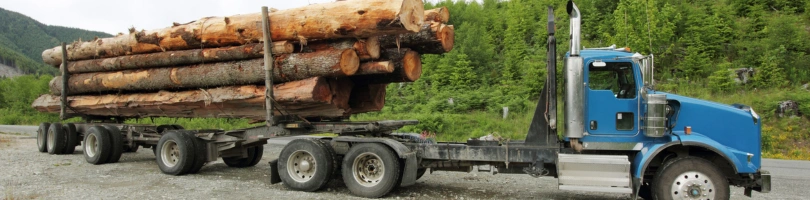
Most commercial trucks are predictable in how they behave and what they carry. Logging trucks are different. Full‑length timber logs or processed lumber vary in size, shape, and weight, creating instability that no amount of driver skill or equipment can fully eliminate. When a loaded logging truck travels I‑85 near Gaston County, navigates Charlotte’s I‑277 loop, or turns onto busy arterial roads, the cargo shifts unpredictably.
Restraints can fail, drivers may overcorrect, or mechanical issues may arise at highway speed. Loose logs become deadly projectiles, crushing vehicles and occupants, making logging truck accidents among the most severe and complex cases.
What Makes Logging Truck Accidents So Dangerous
At the national level, FMCSA data for 2023 shows that large trucks were involved in 168,738 crashes, resulting in 5,405 fatalities and 76,429 injuries, figures that underscore the severity of commercial vehicle accidents as a nationwide safety concern. Understanding why collisions involving logging trucks produce the outcomes they do is important for both accident victims and the legal case that follows.
The Nature Of The Cargo
Timber loads differ fundamentally from boxed freight, liquid cargo, or flatbed materials. Tree trunks and logs vary in length and shape, with friction and density shifting as the truck moves. Proper chaining and stacking reduce risk, but even well‑loaded trucks can become dangerous during sharp maneuvers, sudden braking, or collisions, when irregular logs shift unpredictably and turn into hazardous projectiles.
A load shift at speed, particularly on an overloaded cargo truck, can cause a driver to lose directional control within seconds. By the time a rollover begins, neither the driver nor nearby motorists has meaningful time to react.
Rollover Risk
The high center of gravity of a fully loaded logging truck makes it inherently more prone to rollover than a lower-profile commercial vehicle. Curves, ramps, uneven road surfaces, and evasive maneuvers all create conditions that can cause a loaded log truck to tip. When a rollover occurs on an interstate, the cascading consequences, including debris fields, secondary crashes, and road closures, frequently create injuries far from the initial point of the accident.
Cargo Spillage And Road Hazards
When logs break free from their restraints, they do not land predictably. They roll, bounce, and tumble across multiple lanes of traffic. Other drivers, including those in blind spots beside or behind the logging truck who had no warning of the failure, can be struck before they have any opportunity to brake or steer away. The resulting injuries from direct log contact are typically severe and often fatal.
Stopping Distance And Size
A fully loaded logging truck can legally weigh up to 80,000 pounds under federal regulations. At highway speeds, the stopping distance required by that mass is dramatically greater than what a passenger vehicle driver anticipates. Fatigued truck driving, distraction, or impairment reduces a driver’s reaction time even further, turning what might have been an avoidable near-miss into a catastrophic collision.
Mechanical Failures
Logging trucks operate in harsh conditions, on unpaved access roads through active timber operations, and then directly onto public highways. Brakes, tires, and load-securing hardware all experience accelerated wear in these environments. A mechanical defect that might cause a minor problem in a well-maintained highway truck can cause a catastrophic failure in a logging truck with deferred maintenance. Brake failures and tire blowouts are among the most dangerous failures in vehicles of this weight class.
Our Charlotte logging truck accident attorneys examine load records, driver logs, maintenance histories, and manufacturer specifications to identify every responsible party.
Who May Be Held Liable After A Charlotte Logging Truck Accident
One of the most important aspects of a logging truck accident case is determining which parties bear legal responsibility, because that determination directly affects the amount and sources of compensation available to an injured victim. Logging operations often involve multiple distinct entities, each with potential liability.
The following parties may share responsibility:
- The logging truck driver for negligent driving, fatigue, impairment, or failure to properly secure the load
- The timber company or logging operation under respondeat superior if the driver acted within employment scope, or directly if unsafe vehicles, fatigued driving, or unrealistic schedules were allowed
- The company that loaded the truck when improper stacking, binding, or cargo configuration caused a load shift or spillage
- Vehicle maintenance contractors if mechanical failure resulted from inadequate inspection or servicing
- Equipment manufacturers when defective components such as braking systems, trailers, or load‑securing hardware fail under normal operating conditions
- Government entities if road defects, inadequate signage, or unsafe road design contributed to the crash
Our Charlotte logging truck accident lawyers conduct thorough investigations to identify every potentially responsible party and pursue compensation from each one whose negligence contributed to your injuries.
Federal Regulations Governing Logging Truck Operations
Commercial logging trucks operating on North Carolina public roads are subject to federal regulations administered by the Federal Motor Carrier Safety Administration. These regulations establish specific requirements that, when violated, constitute evidence of negligence in a logging truck accident claim.
Hours-of-service regulations under 49 C.F.R. Part 395 limit the number of consecutive hours a commercial driver may operate without rest. Violations of these rules are a common contributing factor in fatigued-driving crashes.
Cargo securement standards under 49 C.F.R. Part 393, Subpart I, govern specifically how timber and logs must be secured during transport, including requirements for the number and placement of tiedowns, the working load limit of securing devices, and the use of stakes, wrappers, and binders.
Vehicle maintenance and inspection requirements under 49 C.F.R. Part 396 require commercial carriers to regularly inspect vehicles, maintain records of inspections, and ensure that all components are in safe operating condition before a vehicle is placed in service.
When our Charlotte truck accident lawyers find evidence that any of these federal standards were violated, that evidence becomes a powerful foundation for establishing negligence in your claim
Securing Compensation for Your Injuries in Charlotte
Logging truck accident victims can recover economic and non-economic damages. Medical expenses cover emergency care, surgery, hospitalization, rehabilitation, ongoing treatment, and future medical needs. Lost wages compensate income lost while recovering. Permanent disability reduces future earning capacity, requiring lifetime compensation calculations.
Non-economic damages address pain and suffering, emotional trauma, loss of enjoyment of life, and permanent physical limitations. Serious logging truck injuries causing visible scarring, disfigurement, or permanent disability justify substantial non-economic compensation.
Wrongful death claims allow surviving families to pursue compensation when logging truck accidents prove fatal. These claims recover funeral expenses, lost household income, and the profound emotional loss of losing a loved one.
Visit Our Logging Truck Accident Attorneys in Charlotte, NC
Working With Stewart Law Offices on Your Case
Charlotte logging truck accident claims demand experienced legal representation. Insurance companies protecting logging companies and operators deploy sophisticated defense strategies. Early settlement offers ignore future medical needs and permanent limitations. Insurance adjusters question liability through comparative negligence arguments.
Stewart Law Offices investigates logging truck accidents thoroughly, identifying all responsible parties and evidence supporting your claim. We work with accident reconstruction experts, medical specialists, and industry investigators to build compelling cases. Elizabeth Von Cannon and our team negotiate aggressively with insurance companies and litigate in court when necessary.
We work on contingency, meaning you pay nothing unless we recover compensation. Your focus remains on healing while we manage complex legal proceedings.
Contact Stewart Law Offices at (704) 521-5000 or online to schedule your free consultation. We serve Charlotte and Mecklenburg County with a commitment to helping logging truck accident victims rebuild their lives after catastrophic injury.
Frequently Asked Questions About Logging Truck Accidents in Charlotte
North Carolina allows strict product liability claims against manufacturers of defective truck equipment, including brakes, trailers, coupling systems, and cargo restraint devices. Strict liability means you need not prove negligence; you only need to show that the product was defective and that the defect caused injury. This applies to logging truck equipment failures causing accidents in Charlotte. Identifying defective equipment through investigation can significantly increase your claim value and expand the responsible parties beyond the truck operator and logging company. North Carolina’s contributory negligence rule bars all recovery if you are found even one percent at fault for your accident in Charlotte. This harsh rule requires a thorough investigation to prove that the logging truck driver or the company is fully responsible. Our truck accident attorneys build cases emphasizing the negligence of logging truck operators while defending against comparative fault arguments from insurance companies protecting trucking interests. If an insurer tries to blame you for a logging truck accident in Charlotte, North Carolina, under the state’s contributory negligence rule, a Charlotte logging truck accident lawyer can review the evidence, challenge unfair fault assignments, and present facts showing that the truck driver, company, or loader was responsible, helping protect your ability to recover compensation despite the strict legal standard.