
Charlotte Jackknife Accident Lawyer
Legally Reviewed by the Stewart Law Offices Content Team: Sep 19, 2026
When a fully loaded commercial truck loses traction and its trailer swings wildly across multiple lanes of traffic, a jackknife accident creates one of the most terrifying and dangerous situations on the road. Other motorists have only seconds to react as a massive piece of equipment slides out of control, potentially crushing vehicles in its path or sending cars careening into concrete barriers, other trucks, or off roadways altogether. If you or someone you care about was injured in a jackknife accident in Charlotte or across Mecklenburg County, North Carolina, you need legal representation from attorneys who understand the complexity of these cases.
 At Stewart Law Offices, we have built a practice around representing victims of catastrophic truck accidents. Our legal team includes Elizabeth Von Cannon, a licensed North Carolina State Bar attorney who brings more than six years of focused experience representing individuals harmed in serious truck accident cases. Elizabeth works directly with injured clients throughout Charlotte and all across Mecklenburg County, devoting herself to each case with careful attention and thorough preparation.
From the moment you contact our firm, you are working with attorneys who take your injuries seriously and who commit to fighting for the maximum compensation available under the law. A Charlotte jackknife accident lawyer from Stewart Law Offices can review your situation at no cost and explain what your legal options look like.
What Is A Jackknife Accident?
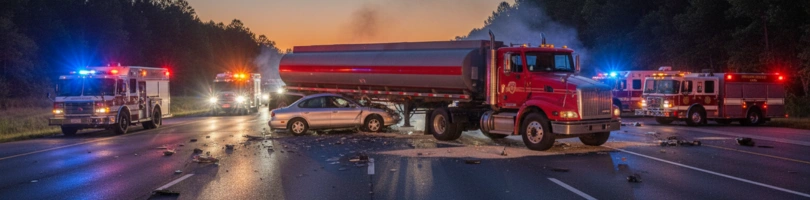
A jackknife accident occurs when a truck’s cab and trailer fold toward each other at a sharp angle, often because the trailer loses traction and swings out of line with the tractor. This sudden folding motion can send the trailer across multiple lanes, block traffic, and trigger secondary collisions with nearby vehicles.
Because of the size and weight of commercial trucks, jackknife accidents are particularly dangerous. Victims in smaller vehicles can suffer crushing impacts, rollovers, or being forced off the roadway. These crashes are especially common on high‑speed corridors and tight curves, including interchanges near Uptown Charlotte and busy industrial areas where heavy truck traffic and sharp turns increase the risk of a Sharp Turn Truck Accident.
Why Jackknife Accidents Happen
Understanding what triggers a jackknife is essential to identifying who is responsible and what evidence our attorneys will need to build your case. The most common causes include:
Sudden or Improper Braking
Slamming the brakes on a loaded tractor-trailer at highway speed can lock the rear trailer wheels while the cab continues to move forward, triggering a jackknife. Experienced commercial drivers are trained to apply brakes gradually and in a controlled manner. When a driver panics or brakes improperly due to inattention, the result is a loss of trailer control that they may be powerless to reverse once it begins.
Excessive Speed
A truck operating above a safe speed for road conditions has a dramatically reduced stopping distance and far less margin for error in any emergency. Speed-related crashes remain a leading cause of fatal large-truck accidents in North Carolina. According to the Insurance Institute for Highway Safety, 5,340 people died in large truck crashes nationwide in 2024, with passenger vehicle occupants accounting for 65 percent of those fatalities. On the open stretches of I-85 through Mecklenburg County, where commercial trucks routinely travel at or above 70 mph, a speeding accident can escalate to a jackknife in moments.
Fatigued Driving
Federal hours-of-service regulations limit the consecutive driving time for commercial truck operators, but violations are common and difficult to detect without professional investigation. A fatigued driver reacts more slowly to road changes, makes poorer braking decisions, and is less equipped to manage vehicle instability. Our Charlotte jackknife accident lawyers review driver logs and electronic logging device records to determine whether fatigue contributed to your crash. Cases involving fatigued truck driving frequently support additional liability against the trucking company for pushing drivers beyond safe limits.
Improperly Loaded Or Overloaded Cargo
Cargo that is unevenly distributed, unsecured, or loaded beyond the truck’s legal weight limit shifts during transit, throwing off the vehicle’s center of gravity. An imbalanced load can cause trailer instability that the driver cannot correct, particularly during a sudden lane change or when braking on a curve. If an overloaded cargo truck contributed to the jackknife, liability may extend beyond the driver and carrier to whoever was responsible for loading the freight.
Mechanical Defects And Neglected Maintenance
Braking system failures, tire blowouts, worn coupling mechanisms, and faulty steering components can all contribute to a jackknife event. Federal Motor Carrier Safety Administration regulations require carriers to conduct pre-trip inspections and maintain detailed maintenance records. When a carrier or its maintenance contractors ignore known problems, they create exactly the conditions that lead to catastrophic crashes. Our Charlotte jackknife accident attorneys secure maintenance records and inspection logs early in every case to determine whether a mechanical defect or failure in truck maintenance obligations set the stage for the collision.
Poor Road Conditions And Bad Weather
Wet, icy, or oily road surfaces reduce the friction between tires and pavement, making trailer skids far more likely. Charlotte experiences frequent rain events, and the highway interchanges around the city can become slick with little warning. While weather is not itself a form of negligence, a driver who fails to reduce speed and increase following distance in deteriorating conditions bears responsibility for the consequences of that failure.
Injuries from jackknife truck accidents
Due to the violent forces in a jackknife crash, injuries are often severe and may require long‑term medical care. Common injuries include:
- Traumatic brain injuries ranging from concussions to permanent cognitive impairment
- Spinal cord injuries and paralysis
- Complex fractures and crush injuries to limbs
- Internal organ damage and internal bleeding
- Severe soft‑tissue injuries, burns, and disfigurement
Victims might need emergency surgery, extensive rehabilitation, assistive devices, and home modifications. Many people cannot return to work for months or even permanently, which is why having a Charlotte truck accident lawyer who understands both medical and financial impacts is so important
Who Can Be Held Liable In A Charlotte Jackknife Accident
One of the most important aspects of a jackknife accident claim is that responsibility rarely rests with a single party. Our truck accident attorneys thoroughly investigate every potential source of liability before making any demand.
The Truck Driver
If the driver’s braking technique, speed, fatigue, distraction, or intoxication contributed to the jackknife, they bear personal liability for the resulting harm. Driver qualification records, drug and alcohol test results, and electronic logging device data are all sources of evidence our attorneys pursue promptly.
The Trucking Company
Carriers are responsible for hiring qualified drivers, training them adequately, scheduling them within legal hours-of-service limits, and maintaining their vehicles in safe operating condition. Under the doctrine of respondeat superior, an employer can be vicariously liable for the negligence of a driver who was acting within the scope of their employment at the time of the crash. If the carrier pushed a driver to exceed legal driving time or ignored known vehicle defects, the company’s direct negligence may also support a claim.
Cargo Loading Parties
When an improperly loaded or overweight trailer contributed to the instability that triggered the jackknife, the shipper, freight broker, or third-party loading contractor who prepared the cargo may share liability. Federal regulations establish clear weight and securement standards, and violations of those standards can support both direct negligence claims and regulatory violation arguments.
Vehicle Or Parts Manufacturers
If the jackknife resulted from a defective braking component, a faulty coupling mechanism, or a tire that failed under normal operating conditions, the manufacturer of that defective component may be liable regardless of whether the carrier also shares responsibility. These product liability theories operate independently of negligence and can provide an additional avenue of recovery.
Government Entities
In cases where a road design defect, inadequate signage, poor drainage, or a known hazard on a state or locally maintained highway contributed to the crash, a government entity may bear partial responsibility. Claims against government defendants in North Carolina involve specific procedural requirements, including notice provisions under the North Carolina Tort Claims Act, and our truck accident attorneys are familiar with those requirements.
What Compensation Is Available To Jackknife Accident Victims In Charlotte
A successful jackknife accident claim in North Carolina can recover compensation for the complete scope of what you have lost and suffered, including:
Economic damages covering all past and future medical expenses, including emergency care, hospitalization, surgery, rehabilitation, prescription medications, medical equipment, and ongoing treatment for permanent conditions. Lost wages from time missed at work. Reduced future earning capacity if your injuries prevent a return to your previous employment or limit the type or duration of work you can perform. Property damage, including the repair or replacement of your vehicle and any personal belongings destroyed in the crash.
Non-economic damages for physical pain and suffering, both past and ongoing. Emotional distress, anxiety, and post-traumatic stress disorder. Loss of enjoyment of activities that were meaningful to you before the accident. The impact your injuries have had on your relationships with family members, including loss of consortium claims, where applicable.
Punitive damages in cases where the at-fault party’s conduct was particularly egregious. Under North Carolina General Statute Section 1D-15, punitive damages may be awarded when clear and convincing evidence establishes that the defendant acted with fraud, malice, or willful or wanton conduct. A carrier that knowingly allowed a fatigued driver to operate a poorly maintained vehicle on a busy Charlotte highway may face punitive exposure on top of compensatory damages.
How Stewart Law Offices Handles Charlotte Jackknife Accident Claims
Our approach begins with an immediate response. As soon as we take on a jackknife case, we send preservation letters to all parties who may control relevant evidence, move to secure electronic data before it can be overwritten, and begin building an independent record of what happened and why.
We retain qualified accident reconstruction experts, work with medical professionals to document the full extent of our clients’ injuries and long-term prognoses, and use economic experts where necessary to calculate future lost earning capacity and care costs. We handle all communications with insurance companies, refuse to accept inadequate settlement offers, and prepare every case for trial from the start. That preparation posture matters at the negotiating table.
Our team has recovered millions of dollars for truck accident victims throughout the Carolinas, including multi-million-dollar results in tractor-trailer cases. Prior results do not guarantee future outcomes, as every case turns on its own facts, but our approach to every case reflects what it takes to pursue maximum compensation against well-resourced defendants.
Moving Forward After Your Jackknife Accident
Time is critical after a jackknife accident. North Carolina gives most personal injury victims three years from the date of the accident to file a lawsuit against the at-fault parties. Physical recovery demands your immediate attention. Legal deadlines begin running immediately. Evidence at accident scenes disappears. Witnesses relocate or forget details. Preserving evidence and building your case requires prompt attorney involvement.
Stewart Law Offices works on contingency, meaning you pay nothing upfront and no attorney fees unless we recover compensation for you. Our team handles every aspect of your jackknife accident claim while you focus on healing. We communicate with insurers, manage medical providers, negotiate settlements, and litigate if necessary. Your recovery is our mission.
Frequently Asked Questions About Jackknife Accidents In Charlotte, NC
Yes, jackknife accidents in Charlotte, North Carolina, involve unique liability considerations because the accident typically occurs due to loss of vehicle control rather than a driver simply hitting another vehicle, which means the investigation must focus on whether driver error, mechanical failure, road conditions, or cargo issues caused the loss of control. This complexity makes the role of accident reconstruction experts and vehicle maintenance records particularly important in establishing liability compared to straightforward rear-end or side-impact truck accidents. Yes, multiple parties may share liability for a jackknife accident in Charlotte, North Carolina, including the truck driver for negligent operation, the trucking company for inadequate training or maintenance, maintenance contractors for failed vehicle service, cargo loaders for improper loading, truck manufacturers for mechanical defect, and cargo brokers for misrepresenting load specifications. Determining which parties bear responsibility requires a thorough investigation of the specific circumstances of your accident. Jackknife accidents on Charlotte highways cause secondary collisions because the jackknifed trailer blocks multiple lanes of traffic simultaneously, and drivers traveling behind the jackknifed truck cannot stop in time to avoid a collision. A fully loaded semi-truck requires more than 500 feet to stop from 65 miles per hour, and following vehicles traveling at highway speeds cannot stop more quickly. The wreckage creates instant hazards affecting numerous innocent vehicles.