Understanding Federal Railroad Regulations in Train Accident Claims
Train accidents are primarily governed by federal law, not South Carolina state law. The Federal Railroad Administration (FRA), part of the U.S. Department of Transportation, sets and enforces nationwide railroad safety standards. Violations of these federal regulations are often key evidence in train accident lawsuits.
The FRA regulates critical areas, including:
- Track inspection, maintenance, and repair standards
- Signal systems and grade crossing warning devices
- Locomotive and rail equipment safety requirements
- Hours of service rules for train crews
- Mandatory drug and alcohol testing for railroad employees
- Accident reporting and investigation obligations
Accident reporting is governed by 49 CFR Part 225, which requires railroads to submit monthly reports on highway-rail grade crossing accidents, rail equipment accidents, and casualties to persons. When a reportable accident occurs, the railroad must complete Form 55A, and the FRA may initiate a formal investigation. FRA investigates accidents meeting Class A criteria, including any collision or derailment resulting in fatalities or serious injuries, any Amtrak passenger train accident, and accidents involving significant hazardous materials release.
While federal regulations dominate railroad safety, South Carolina law still applies to certain aspects of a civil claim (such as the statute of limitations and damages). However, proving negligence in train accidents frequently relies on showing violations of the above federal standards.
Train Accident Settlements
More than 95% of all railroad fatalities are attributable to trespassers and grade crossing users, according to FRA data, meaning the overwhelming majority of train-related deaths are people outside the train, not passengers. If you have been involved in an accident with a train, the amount of compensation that you may be eligible to receive will vary depending on your relationship with the responsible party. The railroad’s duty of care to accident victims varies for train car passengers, motor vehicle occupants, or pedestrians.
Depending on the circumstances of your accident, a lawyer can help you choose the best path forward. Train companies that are looking to avoid publicity may prefer to settle out of court. In many cases, an out-of-court settlement is also in the best interest of the accident victim, as it can expedite the process and allow families to receive the compensation that they need.
In some instances, train accident victims may stand to gain much more from the liable party if a jury weighs in on the accident. An attorney at the Stewart Law Offices can help you figure out what is best for you in the aftermath of a train accident.
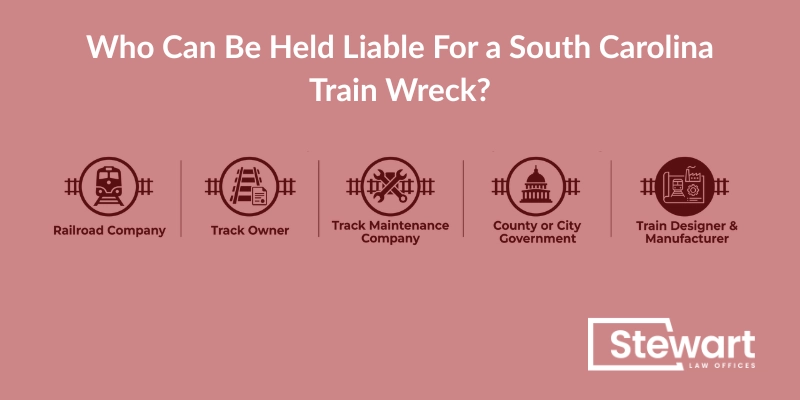
Who Can Be Held Liable For a South Carolina Train Wreck?
Establishing responsibility in the wake of a train accident can be complicated and will depend on the factors that caused the accident. If it is found that the parties involved in a train accident have been negligent, any or all of the responsible parties could be liable for covering your expenses as a victim. These parties could include:
- Railroad Company – The company responsible for the train’s operation, no matter the cargo, could be held responsible for accidents as a result of failing to ensure the safe operation of the locomotive and railcars.
- Track Owner – In some cases, the company that owns the railroad tracks is not the same company that owns and operates the train. The track owner could be held liable if problems with the railroad itself caused the crash.
- Track Maintenance Company – Safety issues involving improper maintenance and repair of train tracks can cause derailments or accidents due to obstructions.
- A County or City – In some rare instances, the municipality in which the train track is located can be held responsible for an accident. This is most common when the streets surrounding railroad crossings are not properly maintained.
- Train Designer and Manufacturer – If the train was poorly designed, wasn’t properly tested, or was built with defective parts, the company responsible could be held liable for the damage their negligence causes.
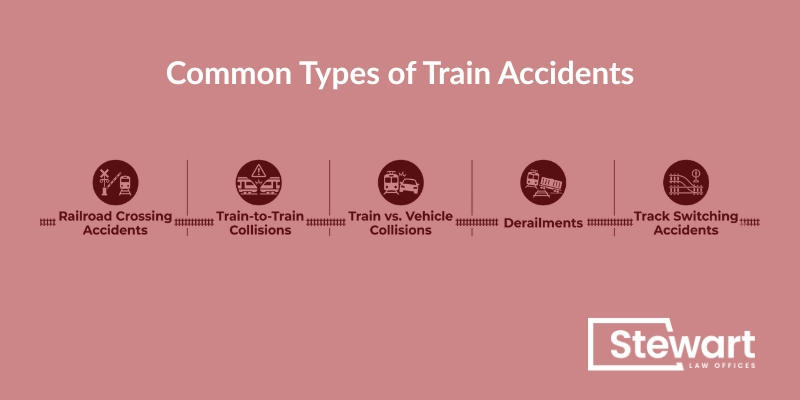
Types of Train Accidents
According to Operation Lifesaver, a nonprofit that publishes FRA data in summary form, the number of train/motor vehicle collisions has been reduced from a 1972 high of roughly 12,000 annual incidents to approximately 2,226 incidents in 2025, reflecting decades of safety improvements. However, thousands of grade crossing collisions still occur each year, and fatalities remain persistent. Accidents that often leave trains with minimal damage can cause serious, life-changing injuries to the occupants of the other vehicles involved. Some common accidents involving trains include:
- Railroad crossing accidents
- Trains colliding with trains
- Trains colliding with cars
- Derailments
- Track switching accidents
Unfortunately, railroad crossing accidents can occur due to multiple factors. If an object obstructs the crossing and the train does not have enough time to stop, a collision is imminent. Broken lights and crossing signals can put both motor vehicles and train occupants at serious risk. Failure to signal on behalf of the train operator can also cause devastating railroad crossing accidents.
For crossing accidents, the railroad company should ensure that the crossing is safely marked, the signals are working properly, and cars and other commuters can pass over the crossing safely and without obstruction. If a passenger, cyclist, or pedestrian is put in harm’s way when a railroad company fails to secure the crossing, the potential damage caused could be fatal and the train company is likely liable for any damages caused.
However, if a vehicle, cyclist, or pedestrian fails to observe crossing safety standards, or chooses to cross the railroad in non-designated areas, then the company is rarely responsible for any injury that is caused. In fact, the motorist could be liable to train occupants for an accident in such situations.
In addition to crossing accidents, derailments can be caused by various factors. If the cargo weight loaded onto the train is excessive or improperly loaded, the train can be susceptible to derailing. Additionally, poorly maintained and obstructed tracks pose a serious threat, especially when trains are traveling at high speeds. Operator error can also be to blame for derailments. Failing to observe the proper speeds can put train passengers and nearby people, vehicles, and buildings at serious risk.
Common Causes of Train Accidents in South Carolina
Establishing the cause of a train accident is critical to identifying who is liable and building a successful claim. Common causes our attorneys investigate include:
- Train conductor or engineer error, traveling too fast, running a red signal, or distracted operation
- Faulty or malfunctioning grade crossing warning devices
- Track defects, including worn, warped, or broken rails
- Improper track maintenance or missed inspection requirements
- Signal failures or miscommunications between dispatch and engineers
- Excessive or improperly secured cargo causes instability
- Equipment defects, failed brakes, malfunctioning switches, defective parts
- Hours-of-service violations causing crew fatigue
- Drug or alcohol impairment by the train operating crew
- Blocked or obstructed crossings due to railroad operations under the FRA blocked crossing reporting requirements
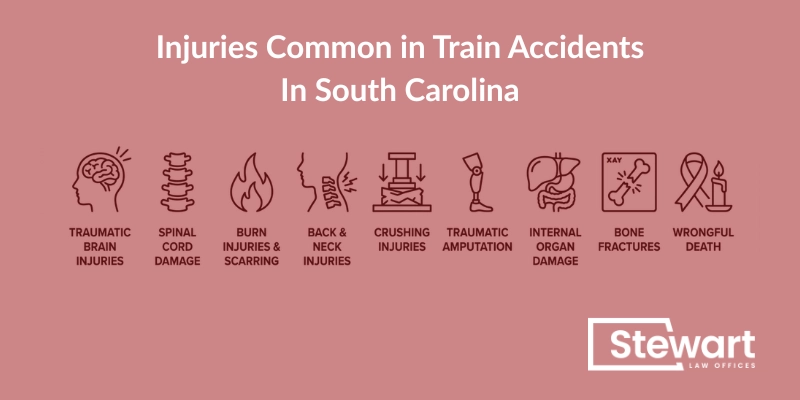
Injuries Common in Train Accidents
Because trains are enormous vehicles, a collision with another vehicle or person can be fatal. Common injuries resulting from a train accident include:
- Traumatic brain injuries, ranging from concussions to severe TBIs with permanent cognitive impairment
- Spinal cord damage, which can lead to temporary or permanent paralysis
- Burns from post-collision fires or explosions, which may result in permanent scarring
- Back and neck injuries, including herniated discs and fractures
- Crushing injuries from heavy falling objects or train components
- Traumatic amputation
- Internal organ damage
- Bone fractures requiring surgical repair
- Wrongful death
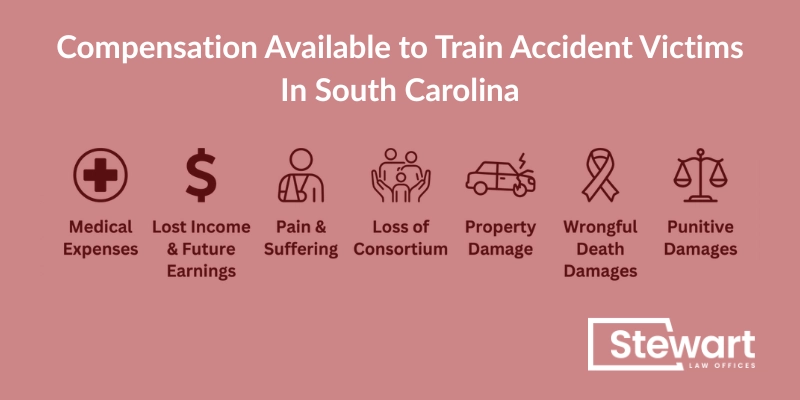
Compensation Available to Train Accident Victims
Under South Carolina law, you may be entitled to compensation for your injuries if you are involved in a train accident. Each case is different, but a successful claim may recover:
- Medical expenses, both current and future
- Loss of income, both current and future
- Pain and suffering
- Loss of consortium
- Property damage
- Wrongful death damages under when a family member is killed
- Punitive damages in cases of especially reckless or willful conduct
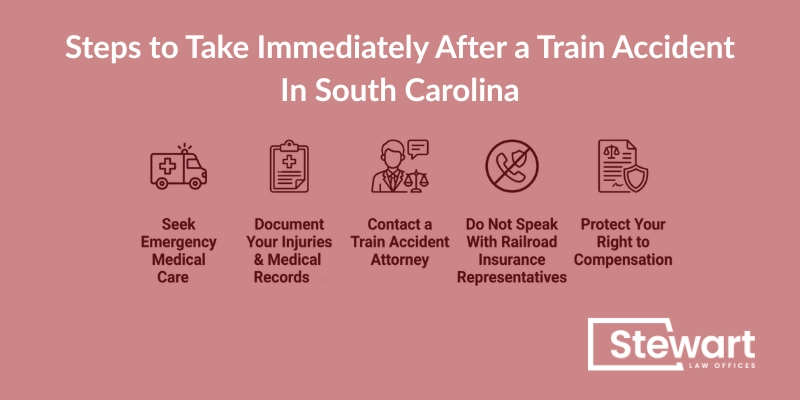
Steps to Take Immediately After a Train Accident
After a train accident, the most important thing is your health and safety. If you have sustained serious injuries and need medical treatment of any kind, make sure you get to the hospital. To the best of your ability, be clear about how your injuries occurred when talking to your healthcare provider.
Once you’ve secured the emergency medical help that you need, contact an attorney to work on your behalf. Many train accidents cause serious injuries. Of the 1,344 recorded accidents that occurred in South Carolina over a 10-year period, SCDOT reported that 1,056 people suffered injuries, 154 of which were fatal. This sampling indicates that well over half of the train accident victims reported injuries, and over 1 in 8 people died as a result of being involved in a train accident.
Railroad companies understand the significant costs associated with liability for accidental injuries and deaths, and they hire skilled legal teams with plenty of resources to defend them from claims. Their lawyers fight to make sure that they protect the companies’ interests at all costs, which is exactly why you need legal representation of your own. An experienced team of train accident attorneys can fight tirelessly on your behalf to make sure that you pursue the compensation that you need to move forward.
Our legal team includes Stephen Suggs, a licensed South Carolina Bar personal injury attorney with more than 25 years of experience handling complex injury claims and protecting the rights of victims throughout the state.
If you receive any calls from a railroad company’s insurance adjuster or lawyer, you can decline the call and refer them to your attorney. The company may try to put you directly in touch with their legal team to answer questions, but you should always consult with your lawyer before speaking with anyone.
Speak with Our Train Accident Lawyers Today
The South Carolina personal injury attorneys at the Stewart Law Offices understand the serious challenges that victims of railroad accidents face. Coping with the physical and financial challenges of an injury can seem impossible when you don’t have the resources you need. Our lawyers appreciate this, which is why we apply our legal experience to the benefit of accident victims.
When we fight for you, we do not accept payment unless we are able to secure financial compensation for you*. Legal representation should not be another financial burden for you, so we make sure you have one less worry. If you have been involved in an accident, don’t wait to find out how you could benefit from legal representation.

 Have you been injured in an accident involving a train? The South Carolina train accident attorneys at the Stewart Law Offices are ready to help. Our firm was founded by Brent Stewart, a licensed attorney and member of the South Carolina Bar, who brings more than 30 years of legal experience to every case. We fight for those who have been seriously injured or lost a loved one in a train accident in North Carolina or South Carolina, including clients throughout York County, Greenville County, Aiken County, Richland County, the Lowcountry, and communities across the state.