Understanding North Carolina Dog Bite Liability
North Carolina’s legal framework for dog bite cases combines common law principles with specific statutes. Victims may pursue claims under the traditional one-bite rule (scienter), general negligence, negligence per se (from local leash law violations), or strict liability for dogs officially designated as dangerous.
The One-Bite Rule and Negligence
For dogs that have not been declared dangerous, North Carolina courts generally follow the scienter (one-bite) rule. Under this rule, the victim must prove that the owner knew or reasonably should have known that the dog had dangerous or vicious propensities. This knowledge can come from prior bites, aggressive behavior (such as charging, snapping, or growling), or the dog’s breed propensities if known to the owner.
Strict Liability for Dangerous Dogs
If a dog has been officially designated as “dangerous” or “potentially dangerous,” the owner faces strict liability for any injuries or property damage the dog causes. No proof of prior knowledge is required.
Under N.C. Gen. Stat. § 67-4.1, a dog may be classified as dangerous if it has, without provocation, killed or inflicted severe injury on a person, killed or severely injured a domestic animal off the owner’s property, or approached a person in a vicious or terrorizing manner.
The owner of a dangerous dog is strictly liable in civil damages under N.C. Gen. Stat. § 67-4.4. A criminal misdemeanor may also apply if the attack causes injuries requiring medical treatment exceeding $100.
Negligence Per Se Through Local Leash Law Violations
Most cities and counties in North Carolina have animal control ordinances requiring dogs to be leashed or properly restrained. Violating these local rules can establish negligence per se, meaning the owner is considered to have breached their duty of care without further proof of unreasonable conduct.
Additionally, N.C. Gen. Stat. § 67-12 makes it a Class 3 misdemeanor for an owner to allow a dog over six months old to run at large, unrestrained at night.
North Carolina’s Contributory Negligence Rule
North Carolina is one of only a few states that still applies pure contributory negligence. If the injured person is found to be even 1% at fault for the incident (for example, by provoking the dog or trespassing), they may be completely barred from recovering any compensation. Insurance companies frequently raise this defense, so strong evidence and experienced legal representation are essential from the very beginning of the case.
What Qualifies a Dog as Potentially Dangerous or Dangerous in North Carolina?
The official designation of a dog as dangerous or potentially dangerous is one of the most consequential facts in any North Carolina dog bite case, because it determines whether strict liability applies, eliminating the need to prove the owner’s prior knowledge entirely.
- Under N.C. Gen. Stat. § 67-4.1(a), a dangerous dog is one that has, without provocation, killed or inflicted severe injury on a person, or has been previously declared potentially dangerous and then repeated the same type of threatening or harmful behavior.
- A potentially dangerous dog is one that has, without provocation, bitten a person causing broken bones or disfiguring lacerations, killed or seriously injured a domestic animal while off the owner’s property, or approached a person in a vicious or threatening manner off the owner’s property.
Our attorneys investigate official records from animal control agencies, including those serving Mecklenburg, Wake, Guilford, Forsyth, Buncombe, and Cumberland counties, to determine whether the dog involved in your attack had any prior designation or documented history of aggression. Even without an official designation, prior complaints and reports can serve as powerful evidence of the owner’s knowledge.
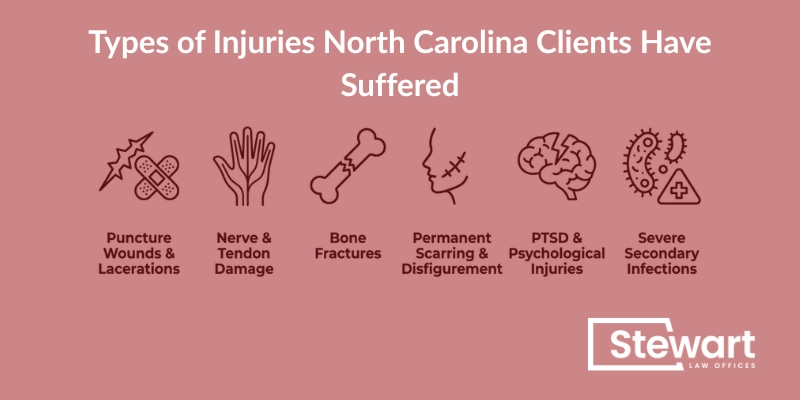
Types of Injuries Our North Carolina Clients Have Suffered
Dog attacks can cause a far wider range of injuries than many people realize. Our North Carolina attorneys have experience representing victims who have suffered all the following types of harm:
Puncture Wounds and Lacerations:
These injuries often penetrate deep through skin, muscle, and tissue. Dog bites introduce dangerous bacteria (like Pasteurella, Streptococcus, and Capnocytophaga) deep into the wound, creating an immediate and potentially life-threatening infection risk if not treated aggressively within days.
Nerve and Tendon Damage
This is particularly common when victims instinctively raise an arm to defend themselves. The resulting damage can lead to a permanent loss of function, reduced grip strength, lasting numbness, or a severely limited range of motion in the affected hand or arm.
Bone Fractures
Fractures can result both from the sheer biting force of a large dog and from being knocked to the ground during an attack. Elderly victims face a heightened risk of serious fractures from falling.
Permanent Scarring and Disfigurement
Attacks frequently target the face, neck, and hands. While reconstructive surgery can improve outcomes, it rarely eliminates the visible effects of a severe attack. In North Carolina, courts consider disfigurement to be a compensable injury separate from general pain and suffering.
Post-Traumatic Stress Disorder (PTSD) and Psychological Injuries
These include behavioral changes, lasting anxiety, nightmares, and phobias (such as fear of public spaces where dogs might be present). North Carolina courts recognize psychological harm as compensable alongside physical injuries, and in severe cases, the emotional toll can persist years after the physical wounds have healed. Children are especially vulnerable to lasting psychological trauma following dog attacks, and specialized therapy may be required for months or years after the incident. Read more about the psychological impact of dog bites on victims and how these damages are evaluated in a claim.
Severe Secondary Infections
These may necessitate hospitalization and include conditions like cellulitis, abscesses, and sepsis. If the attacking dog’s vaccination history is unknown, rabies post-exposure prophylaxis is a critical concern.
Who Can Be Held Liable After a Dog Attack in North Carolina
Liability for a dog bite in North Carolina is not always limited to the registered owner. State courts have established that liability can extend to other parties, including:
- Landlords: If a landlord knew a dangerous dog was on their rental property and had the legal right to remove it, but failed to do so.
- Property Owners: Anyone who permits a known dangerous dog onto their premises.
- Temporary Caretakers: Any person who had care, custody, or control of the dog at the time of the attack. This may include dog sitters, house guests, or family members, who can be treated as an “owner” under North Carolina liability law.
The main source of compensation in most North Carolina dog bite cases is the dog owner’s homeowner’s or renter’s insurance policy. However, unlike car accident claims, dog bite claims frequently encounter coverage disputes. Insurers may attempt to deny coverage based on breed exclusions, argue the attack occurred outside of covered circumstances, or file a declaratory judgment action to seek a court ruling that the claim is not covered. Our North Carolina personal injury attorneys are prepared to challenge these positions and identify all available sources of compensation, including direct civil claims against the responsible party when insurance coverage is disputed or unavailable.
How Dog Bite Insurance Claims Work in North Carolina
Understanding the insurance system is critical to pursuing full compensation after a dog attack.
Most homeowners’ and renters’ insurance policies provide liability coverage for dog bites, both on and off the insured property, as long as the dog is owned or kept at that residence. The liability limits in standard homeowners’ policies often range from $100,000 to $300,000, though umbrella policies can extend coverage significantly higher.
However, insurance companies do not simply pay what your claim is worth. Adjusters will look for reasons to minimize payouts, including disputing the severity of your injuries, claiming you provoked the dog, arguing breed exclusions apply to the policy, or suggesting the attack happened outside covered circumstances.
North Carolina’s pure contributory negligence rule makes this especially dangerous. If an insurer can establish even a small degree of fault on your part, claiming you approached the dog too quickly, failed to heed warning signs, or were somewhere you should not have been, your entire claim could be defeated. Our attorneys anticipate these tactics and build your case with the evidence needed to counter them.
If the dog owner has no homeowners’ or renters’ insurance, or if coverage is excluded or disputed, your attorney will explore all direct claims against the owner’s personal assets and any other potentially liable parties.
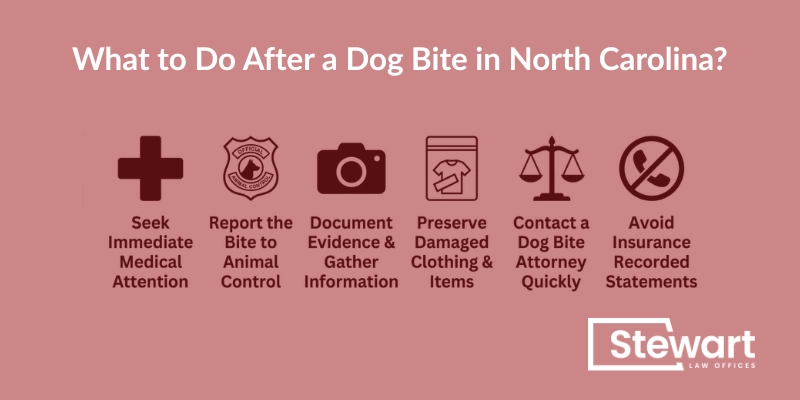
What to Do After a Dog Bite in North Carolina
The actions you take immediately after a dog attack can significantly affect both your medical recovery and the strength of your legal claim.
- Seek medical attention immediately, even if the wound does not appear severe. Dog bites frequently introduce bacteria deep into tissue, making prompt evaluation essential to prevent serious infection. Emergency care or urgent care facilities throughout North Carolina, from large hospital systems in Charlotte and Raleigh to regional facilities in cities like Asheville, Wilmington, Greenville, and Fayetteville, can assess and treat your injuries and create the medical documentation your claim depends on.
- Report the bite to your local animal control authority. This creates an official record of the incident, initiates an investigation into the dog’s history, and protects the public from future attacks. Contact the animal control office serving your county, such as Mecklenburg County Animal Care and Control, Wake County Animal Services, or the relevant authority in your area.
- Document everything you can safely collect. Photograph your injuries from multiple angles and at different stages of healing. Photograph the scene, the dog (from a safe distance), and any evidence of how the attack occurred. Collect the dog owner’s name, address, and insurance information. Obtain the names and contact details of anyone who witnessed the attack.
- Preserve any clothing or belongings damaged or bloodied during the attack. These items may serve as physical evidence of the severity of the incident.
- Contact a North Carolina dog bite attorney as quickly as possible. Evidence disappears. Witnesses become harder to locate. Animal control records need to be formally requested. The dog’s prior history of aggression must be investigated before it is forgotten or disputed. Early legal involvement protects all of this.
- Do not give a recorded statement to the dog owner’s insurance company before consulting an attorney. Adjusters are trained to use your own words against you under North Carolina’s contributory negligence doctrine.
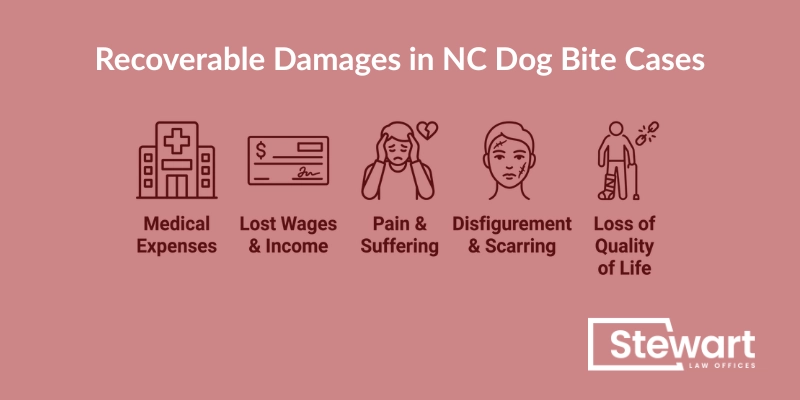
Recoverable Damages in NC Dog Bite Cases
In North Carolina, victims of dog bites are entitled to recover extensive compensation for their losses, which includes:
Medical Expenses
Covering all necessary treatment, from emergency care at major North Carolina facilities to ambulance services, surgery, hospital stays, prescription drugs, physical therapy, reconstructive procedures, and psychological counseling. This also includes the cost of future medical care for any lasting complications.
Lost Wages and Income
Compensation for income lost during recovery. We calculate both past wages lost and the reduction in future earning potential resulting from permanent injuries or disabilities that limit the ability to return to a previous job or work capacity.
Pain and Suffering
Compensation for physical agony, emotional distress, anxiety, depression, and a diminished overall quality of life. Significant compensation is warranted for permanent disfigurement, scarring, and psychological trauma, extending beyond purely financial losses.
Disfigurement and Scarring
Damages specifically addressing permanent cosmetic damage, particularly facial injuries, which can negatively impact self-esteem, social interactions, personal relationships, and professional opportunities.
Loss of Quality of Life
Damages are awarded when injuries prevent victims from enjoying activities they previously engaged in, such as sports, outdoor recreation at North Carolina’s parks and beaches, hobbies, or physical time spent with family.
Time Limits for Filing Your Claim
North Carolina imposes strict deadlines for personal injury claims, including those arising from dog attacks or animal bites.
You generally have three years from the date of the attack (or from when the injury becomes apparent or reasonably should have become apparent) to file a personal injury lawsuit under N.C. Gen. Stat. § 1-52. For wrongful death claims, the applicable deadline under N.C. Gen. Stat. § 1-53 is two years from the date of the victim’s death, not the date of the attack. Missing this statute of limitations usually results in the court dismissing your case entirely, without considering the facts or merits of your claim.
Evidence preservation is critical immediately after an attack. Photographs, witness memories, animal control records, and medical documentation must be gathered quickly before evidence disappears or memories fade.
Contact us immediately to protect your rights and ensure important deadlines are met.
Contact a North Carolina Dog Bite Lawyer Today
Dog attacks cause devastating injuries that no victim should face alone. North Carolina’s hybrid dog bite laws protect victims under certain circumstances, but the state’s harsh contributory negligence rule creates challenges that insurance companies exploit. You need experienced legal representation that understands North Carolina’s complex laws and knows how to build strong cases while defeating victim-blaming defenses.
If you’ve been injured in the Charlotte, NC area, working with a Charlotte dog bite lawyer can make a critical difference in how your claim is handled and the compensation you recover.
Stewart Law Offices has protected the rights of North Carolina dog bite victims for years. We know North Carolina dog bite law, understand what evidence wins cases, and possess trial experience to take cases to court when insurance companies refuse fair settlements.
Call Stewart Law Offices at 866-783-9278 today for your free North Carolina dog bite free case evaluation. We’ll review your injuries, explain your rights under NC law, and chart the path forward to securing the compensation you deserve. You deserve full compensation—don’t let negligent dog owners escape responsibility.

 At Stewart Law Offices, every client who comes to us after a dog attack gets the same thing: direct access to their attorney and a team that genuinely cares about the outcome of their case. Attorney Elizabeth VonCannon leads our North Carolina personal injury practice and brings that approach to life every day. As a licensed member of the North Carolina State Bar with more than six years of experience representing injured clients, Elizabeth has built her practice on the belief that the person sitting across from her deserves honest answers, consistent communication, and an attorney who fights as hard as they would for a family member.