

North Carolina Slip and Fall Attorney
Legally Reviewed by Elizabeth VonCannon: Sep 01, 2026
Slip and fall accidents can happen anywhere and to anyone. You may slip and fall in a grocery store aisle, on a sidewalk in front of someone’s home, or in a hallway of a university building. When a fall occurs on someone else’s property, the owner may be liable for your medical expenses, lost wages, and other losses caused by the incident.
Many people don’t think about how serious a slip and fall can be until it happens to them or someone they love. A fall can result in serious injuries, including broken bones, spinal cord injuries, traumatic brain injuries, and soft tissue injuries, all of which may require extensive medical treatment and leave a victim with lasting impairment.
 If you were injured in a slip and fall, contact Stewart Law Offices for a free consultation with one of our North Carolina slip and fall attorneys. We represent injured clients throughout North Carolina. Our legal team includes Elizabeth VonCannon, a licensed member of the North Carolina State Bar with more than 6 years of experience representing slip and fall victims.
We’ll review the incident, explain your options for seeking compensation, and walk you through the next steps to take. We have extensive experience in slip and fall litigation and are here to help guide you throughout the legal process. When you work with us, you’ll speak directly with your lawyer, ensuring clear communication and personalized attention every step of the way. We handle each case with careful attention and genuine compassion, so you can feel supported and confident as we fight to secure the compensation you deserve.
How Common Are Slip and Fall Accidents?
Falls are among the most serious and widespread causes of injury and death in the United States, a fact that underscores exactly why property owners have a legal obligation to maintain safe conditions.
According to the Centers for Disease Control and Prevention (CDC), more than 14 million adults aged 65 and older, approximately one in four, report falling each year. About 37 percent of those who fall report an injury serious enough to require medical treatment or restrict their activities for at least one day, resulting in an estimated 9 million fall injuries annually.
Falls are the leading cause of injury death among older adults in the United States. In 2023, the unintentional fall death rate for adults aged 65 and older was 69.9 per 100,000 population, a figure that has increased steadily over the past two decades.
In North Carolina’s workplaces, falls, slips, and trips remain a leading cause of serious occupational injury. According to the Bureau of Labor Statistics (BLS), falls, slips, and trips resulted in 29 fatal workplace injuries in North Carolina in 2021, one of the top causes of occupational fatality in the state. Nationally, in 2023, falls, slips, and trips accounted for 38.5 percent of all deaths in the construction industry.
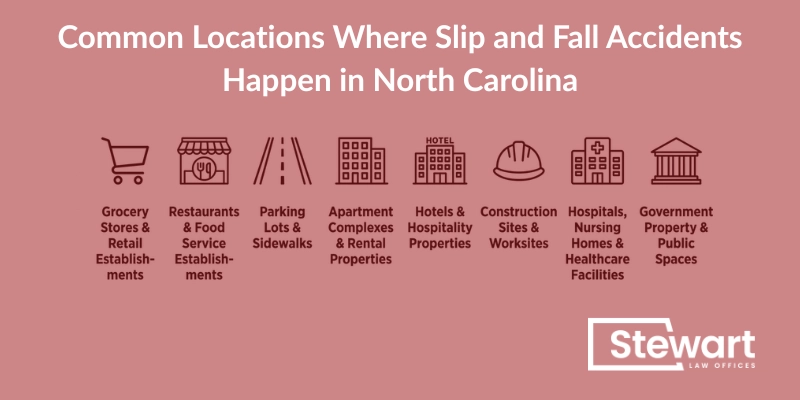
Common Locations Where Slip and Fall Accidents Happen in North Carolina
Slip and fall accidents do not follow a single pattern. They occur across a broad range of settings, and the location of your fall is a key factor in determining who owned or controlled the property, who bears responsibility for maintaining it, and against whom a premises liability claim can be brought.
- Grocery stores and retail establishments — Spilled liquids, freshly mopped floors, fallen merchandise, and uneven flooring are among the most common causes of falls in commercial retail settings. These incidents occur at grocery stores, big-box retailers, and shopping centers throughout North Carolina, including high-traffic commercial corridors in Charlotte, Raleigh, Greensboro, and other metro areas. If you were injured at a major retailer, read our guide on what to do if you slipped and fell at Walmart for specific steps to protect your claim.
- Restaurants and food service establishments — Wet floors near drink stations, uneven transitions between kitchen and dining areas, and dimly lit walkways create consistent fall hazards in food service settings.
- Parking lots and sidewalks — Cracked or uneven pavement, potholes, unmarked curbs, poor lighting, and ice or snow accumulation without adequate treatment make parking lots and sidewalks, both commercial and residential, a frequent site of serious falls. Holiday shopping seasons bring heightened risks in these areas, check our overview of holiday slip and fall accidents for what property owners are required to do.
- Apartment complexes and residential rental properties — Landlords have a duty to maintain common areas, hallways, stairwells, parking areas, laundry rooms, and shared outdoor spaces in a reasonably safe condition. Broken railings, deteriorating stairs, and inadequate lighting in common areas of residential rental properties generate many slip and fall claims.
- Hotels, motels, and hospitality properties — Pool decks, lobby floors, bathroom surfaces, and exterior walkways at hospitality properties create foreseeable fall risks that property owners are obligated to address.
- Construction sites and worksites — Open excavations, unsecured ladders, wet or debris-covered surfaces, and inadequate fall protection on elevated surfaces create serious fall hazards for both construction workers and members of the public who are lawfully on or near job sites.
- Hospitals, nursing homes, and healthcare facilities — Healthcare facilities are required to maintain safe walking surfaces for patients, visitors, and staff. Falls on healthcare property can give rise to both premises liability claims and, in the case of patient falls caused by inadequate monitoring or negligent care, medical malpractice claims.
- Government-owned property and public spaces — Falls on government-owned sidewalks, public parks, courthouses, schools, and other state or municipal property require special procedural handling under the North Carolina Tort Claims Act. Claims against government entities must comply with specific notice requirements and may have shorter deadlines than standard premises liability claims against private parties.
How to Prove a Slip and Fall Case in North Carolina
To recover compensation for a personal injury claim for slip and fall damages in North Carolina, you must prove the property owner or manager was negligent. For a full breakdown of how North Carolina law applies to these cases, see our guide on slip and fall accidents in North Carolina: laws, liability, and claims.
In premises liability cases like those involving slips and falls, this means establishing the following four elements:
- A hazardous condition existed on the property. This could be a puddle in a grocery store aisle, a loose railing on a staircase, or poor lighting in a cluttered hallway.
- The property owner knew or should have known about the hazard. This can involve demonstrating that the hazard was recurring, long-lasting, or that it had been previously reported.
- The property owner failed to fix or warn visitors about the issue. For a wet floor in a store, this could mean employees didn’t clean it up or put out a wet floor warning sign.
- The hazardous condition caused your injury. To do this, you’ll need various types of evidence, such as accident scene photographs, surveillance footage, eyewitness statements, and medical records.
Slip and fall injuries happen every day, but your ability to recover fair compensation may depend on whether you hire an experienced Charlotte slip and fall lawyer.
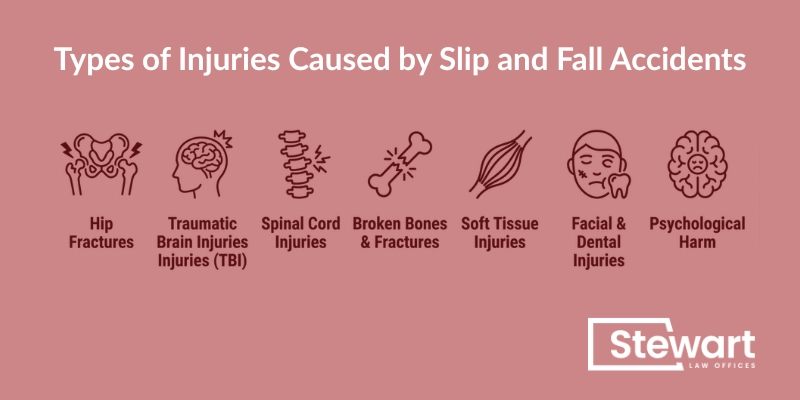
Types of Injuries Caused by Slip and Fall Accidents
Slip and fall accidents can produce injuries ranging from mild soft tissue sprains to life-altering catastrophic harm. The injuries most frequently seen in North Carolina slip and fall cases include:
- Hip fractures — Hip fractures are among the most serious consequences of a fall, particularly for adults over 65. According to the CDC, nearly 319,000 older adults are hospitalized for hip fractures each year, and 83 percent of those fractures result from falls. Hip fracture recovery is lengthy and painful, often requiring surgery, extended rehabilitation, and long-term mobility limitations.
- Traumatic brain injuries (TBI) — Falls are the leading overall cause of TBI-related hospitalizations in the United States, according to the CDC. A head impact during a fall, even at low height and seemingly low force, can produce concussions, subdural hematomas, and other forms of brain injury whose full consequences may not be apparent for hours or days.
- Spinal cord injuries — Falls can compress, fracture, or dislocate vertebrae, causing disc herniation, spinal stenosis, or, in severe cases, partial or complete paralysis. Spinal injuries from falls often require surgery and extended rehabilitation and may result in permanent functional limitations.
- Broken bones and fractures — Beyond hip fractures, falls commonly produce fractures of the wrists, arms, and ankles, particularly when the victim instinctively reaches out to break their fall. These fractures may require surgical fixation and several months of recovery.
- Soft tissue injuries — Ligament sprains, muscle tears, and tendon damage, including torn rotator cuffs and knee ligament injuries, are common in fall accidents and can produce chronic pain and reduced range of motion that persists long after the initial injury.
- Facial injuries and dental damage — Falls that produce face-first impact cause facial lacerations, fractures of the nose and jaw, and dental injuries that may require reconstructive surgery.
- Psychological harm — Serious fall injuries frequently produce lasting psychological effects, including anxiety, depression, and post-traumatic stress disorder (PTSD). Many fall victims also develop a fear of falling that restricts their activity and independence, compounding the physical harm.
How Liability Is Determined in a Slip and Fall Accident
Determining liability in a slip and fall accident case involves identifying the party responsible for maintaining the property and establishing what type of property visitor you are.
In some cases, identifying the party responsible for maintaining the property is simple. A business owner may own the property where the business operates. However, it can get more complicated if the business owner rents the property. Then, you must determine whether the business or property owner is responsible for maintenance.
If your injuries occurred on residential property, you may need to identify whether the residents own or rent it. If they rent, the company or individual from whom they rent may be liable.
Premises liability cases also require establishing what type of visitor the injured party was according to North Carolina law. These visitors could include:
- Invitees are those on a property for business purposes, such as customers in a store.
- Licensees are social guests on a property who are not there for business purposes.
- Trespassers are those on a property without the owner’s permission.
In general, invitees are owed the highest duty of care, while trespassers are owed the lowest. At Stewart Law Offices, our legal team, including Christian Gerencir, a licensed member of the North Carolina State Bar with more than 8 years of experience in handling personal injury cases, can investigate your case and explain if you have a viable slip and fall lawsuit and against whom.
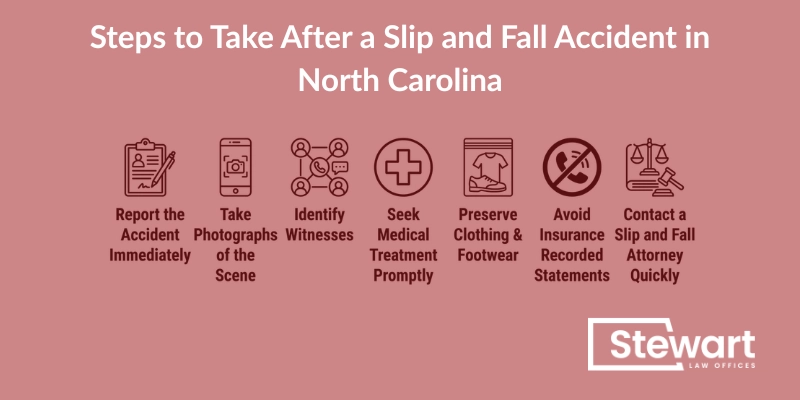
Steps to Take After a Slip and Fall Accident in North Carolina
The actions you take immediately after a fall on someone else’s property can significantly affect your ability to pursue compensation. Follow these steps whenever possible:
- Report the accident immediately. Tell the property owner, manager, or supervisor about your fall before you leave the premises. Request that they complete a written incident report and obtain a copy for your records. If they refuse to provide a copy, note the name and description of the person you reported to.
- Take photographs. Document the exact condition that caused your fall, the wet floor, uneven pavement, broken step, inadequate lighting, or other hazard, as well as the surrounding area, any warning signs that were or were not present, and your visible injuries. Conditions can change rapidly after an incident.
- Identify witnesses. If anyone saw your fall, ask for their name and contact information before you leave. Eyewitness accounts can be critical when the property owner or their insurer disputes the details of what happened.
- Seek medical treatment promptly. Even if your injuries seem minor, get a medical evaluation as soon as possible. Many serious injuries, including concussions and internal damage, are not immediately apparent. Prompt medical treatment also creates the documentation that connects your injuries to the fall, which is essential for your legal claim.
- Preserve your clothing and footwear. The shoes you were wearing and any clothing damaged or soiled in the fall may be relevant evidence. Store them in a safe place and do not clean or discard them.
- Do not give a recorded statement to the property owner’s insurance company. Before speaking with any insurer representing the property owner, contact a North Carolina slip and fall attorney. Insurance adjusters are trained to ask questions in ways that elicit information that can be used to minimize or deny your claim.
- Contact a North Carolina slip and fall attorney promptly. Evidence disappears quickly, surveillance footage is routinely overwritten within days, and hazardous conditions are corrected by property owners almost immediately after an incident. The sooner your attorney can begin investigating, the better your chances of preserving the evidence your case requires.
Can I Sue My Employer for a Slip and Fall Injury at Work in North Carolina?
When a slip and fall injury occurs in the workplace, North Carolina workers’ compensation law generally provides the exclusive remedy against your employer. This means you typically cannot file a civil lawsuit against your employer for the injury.
Under the North Carolina Workers’ Compensation Act (N.C. Gen. Stat. Chapter 97), a workplace slip and fall injury typically entitles you to:
- Medical treatment — All reasonable and necessary medical care related to the injury, paid for by the workers’ compensation insurer.
- Wage replacement benefits — Temporary Total Disability (TTD) benefits equal to two-thirds (66⅔%) of your average weekly wage while you are unable to work.
- Permanent disability compensation — If the injury results in lasting impairment after reaching maximum medical improvement.
However, workers’ compensation benefits do not cover pain and suffering or full lost wages. If a third party’s negligence contributed to your workplace fall, for example, a negligent property owner where you were performing work, a contractor who created an unsafe condition, or an equipment manufacturer whose defective product caused the hazard, you may also have a personal injury claim against that third party, separate from workers’ compensation. Pursuing both claims simultaneously can maximize your total recovery.
What Type of Compensation is Available
The compensation available through a premises liability claim covers economic and non-economic losses caused by the accident. Economic losses are those with tangible value, while non-economic losses are those with personal, intangible value.
Examples of losses you can seek compensation for include:
- Past and future medical expenses related to your slip and fall injuries
- Wages you lost while recovering from your injuries
- Wages you will lose because of how your injuries impact your ability to work
- Physical pain and emotional suffering you experience because of your injuries
- Loss of enjoyment of life caused by your injuries, preventing you from engaging in activities you once enjoyed
- Accommodation for permanent disabilities caused by your injuries
How much compensation you can recover will depend on the specific circumstances surrounding your claim.
Wrongful Death from a Slip and Fall Accident in North Carolina
When a slip and fall accident is severe enough to cause death, especially in cases involving older adults or falls from significant heights, the surviving family members may have grounds to file a wrongful death claim.
Under N.C. Gen. Stat. § 28A-18-2, a wrongful death action can be brought when death results from the wrongful act, neglect, or default of another party. In slip and fall cases, this requires proving the same elements of premises liability negligence (hazardous condition, notice to the property owner, failure to remedy or warn, and causation) plus evidence that the fall directly caused the death.
Wrongful death claims in North Carolina must generally be filed within two years from the date of death. The claim must be brought by the personal representative (executor or administrator) of the deceased’s estate.
Stewart Law Offices handles wrongful death claims arising from slip and fall accidents with the same meticulous preparation and compassionate client service that we bring to all premises liability matters. If your family has suffered this kind of loss, we can evaluate whether a wrongful death claim is available and guide you through the process from beginning to end.
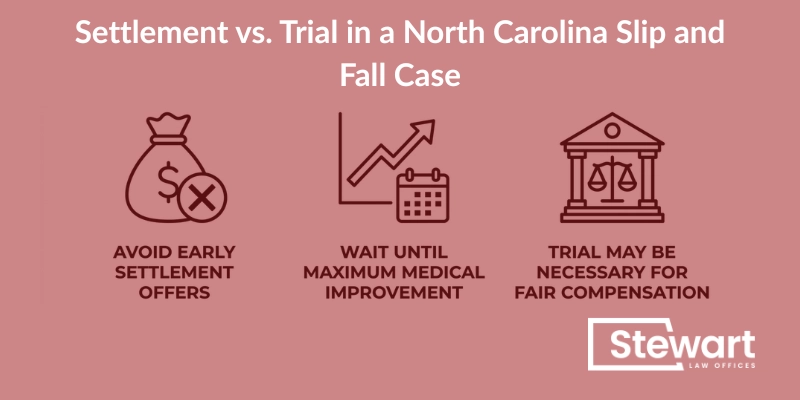
Settlement vs. Trial in a North Carolina Slip and Fall Case
The vast majority of North Carolina slip and fall cases resolve through settlement rather than trial. However, a settlement is only worthwhile if it genuinely accounts for all of your losses — both present and future. Here is what you should know:
- Early settlement offers are almost always inadequate. Property owners’ insurers frequently make prompt settlement offers after a fall, particularly when liability is clear. These early offers routinely fail to account for the full cost of ongoing medical treatment, lost earning capacity, and long-term pain and suffering. Once you sign a release, you permanently give up your right to seek additional compensation, even if your condition worsens.
- Your case should not be settled before you reach maximum medical improvement. Settling before the full extent of your injuries is known means accepting compensation based on an incomplete picture of your losses. At Stewart Law Offices, we advise clients to wait until their medical condition has stabilized before evaluating any settlement offer.
- A trial is sometimes necessary to obtain a fair result. When an insurance company refuses to offer adequate compensation, taking the case to trial before a North Carolina jury may be the only path to justice. Our attorneys prepare every slip and fall case as though it will be tried, which strengthens our negotiating position and ensures we are ready to litigate if settlement fails.
North Carolina Time Limits for Filing a Slip and Fall Claim
Under North Carolina’s statute of limitations for personal injury cases, slip and fall accident victims have three years to file a personal injury lawsuit against the parties responsible for their injuries. You must file your lawsuit within this period to protect your right to obtain compensation. An experienced lawyer for slip and fall cases can file the lawsuit on your behalf within the time limit.
What If I’m Partially at Fault for My Slip and Fall Injury?
Under North Carolina’s contributory negligence rule, if you are partially at fault for your slip and fall injury, you cannot recover compensation. Because this law is so strict, it’s vital that you work with a highly experienced slip and fall lawyer on your case.
The at-fault party’s insurance company will likely try to say that you contributed to your injury so that they can deny your claim. For example, if you slipped in a puddle in a grocery store, they may say that the incident happened because you were looking at your phone rather than where you were walking.
A skilled slip and fall attorney can gather various types of available evidence to show that the other party was at fault for the incident and that you were not.
Contact Our Slip and Fall Lawyers in NC
If you were injured in a slip and fall accident in North Carolina, contact Stewart Law Offices for a free consultation with one of our knowledgeable and compassionate slip and fall lawyers. Our law firm has over 30 years of experience handling cases like yours, and we’re committed to helping you seek maximum compensation.
For your initial consultation, you can come to our office, or we’ll send a lawyer to your home or the hospital to meet with you directly. Our lawyers will be available throughout your case to answer your calls and respond to your messages. We never charge a fee unless we win money for you**, so you don’t have to worry about how you’ll pay for our services.
FAQs About North Carolina Slip and Fall Accident Claims
North Carolina’s pure contributory negligence doctrine is one of the harshest in the country. If the defense can show that you contributed in any way to your fall,, even one percent, you may be completely barred from any compensation. In slip and fall cases, insurers commonly argue the victim was distracted by a phone, wearing inappropriate footwear, ignored an open and obvious hazard, or disregarded a posted warning sign. Your attorney’s job is to build the strongest possible case establishing that the property owner’s failure to maintain safe conditions was the sole cause of your injuries, leaving no credible basis for a contributory negligence defense.
Yes. Nursing homes, assisted living facilities, and other long-term care settings are commercial properties that owe a duty of care to their residents. Falls in these settings often result from inadequate staffing, failure to maintain safe flooring, improper use of assistive equipment, or failure to properly assess and manage a resident’s fall risk. Depending on the circumstances, a fall at a care facility may support both a premises liability claim and a medical malpractice claim against the facility. Given that falls are the leading cause of injury death among older adults, these cases can involve catastrophic damage, including surgery, extended rehabilitation, permanent disability, or death.
Yes, though delays in reporting and treatment can create challenges that an experienced attorney can help you address. A failure to report the incident to the property owner immediately may mean there is no incident report linking your fall to the property’s conditions. A delay in seeking medical care may give the insurer grounds to argue your injuries were not serious or were not caused by the fall. These challenges are not insurmountable; eyewitness testimony, surveillance footage, and medical expert opinions can often bridge the evidentiary gap. However, the sooner you report the accident and seek medical treatment, the stronger your claim will be. Contact a North Carolina slip and fall attorney as promptly as possible after your injury.
The “open and obvious” doctrine is a defense that some property owners raise to argue they had no duty to warn about a hazard that a reasonable person exercising ordinary care should have seen and avoided. In North Carolina, an open and obvious hazard may reduce or eliminate the property owner’s liability, particularly in combination with the contributory negligence doctrine, which can bar recovery if you are found to have failed to notice a plainly visible danger. Whether a condition qualifies as open and obvious is a factual question that depends on the specific circumstances, such as lighting conditions, the nature of the surface, distractions in the environment, and whether the hazard was truly visible. An attorney can challenge an “open and obvious” defense by gathering evidence about the conditions that made the hazard non-obvious or that explain why a reasonable person in your position could not have avoided it.