
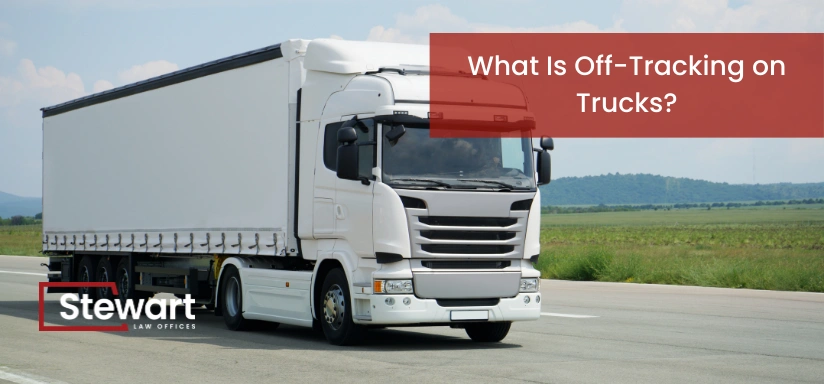
Every turn a truck driver makes carries enormous risk for everyone nearby. When an 18-wheeler navigates an intersection, the front and rear wheels don’t follow the same path—a dangerous phenomenon called off-tracking. The trailer can swing several feet wider than expected, sweeping into adjacent lanes without warning and crushing smaller vehicles, motorcyclists, or pedestrians in its path.
Off-tracking accidents cause devastating injuries throughout the Carolinas. The truck accident attorneys at Stewart Law Offices can investigate what caused your collision and fight to hold negligent truck drivers and trucking companies accountable for the harm they caused.
How Off-Tracking Occurs and Why It’s Dangerous
Off-tracking happens because of the tractor-trailer design. The extended distance between a truck’s front axle and rear trailer wheels means these components trace separate arcs during turns. The rear wheels either cut corners following a tighter radius than the front wheels, or swing outward beyond the front wheel path, depending on turning speed.
This tracking differential can span 10 feet or more during standard 90-degree turns. Tight intersections throughout the Carolinas create catastrophic collision potential. Double and triple trailers compound the effect, with each additional unit magnifying deviation between wheel paths.
Types of Off-Tracking That Cause Accidents
Off-tracking, the phenomenon where a truck’s rear wheels don’t follow the exact path of the front wheels, manifests differently depending on speed.
Low-Speed Off-Tracking
Low-speed off-tracking occurs in slow-speed maneuvers like turning through intersections or warehouse areas. The rear wheels track inside the front wheel path. To compensate, drivers must “swing wide,” moving the truck’s front end into adjacent lanes. This movement can unexpectedly bring the truck’s path into conflict with nearby motorists.
High-Speed Off-Tracking
High-Speed Off-Tracking takes place during faster turns, such as on highway ramps or curved interstate sections (like I-26, I-77, I-85, and I-20). Here, centrifugal force pushes the trailer outward, causing the rear wheels to track outside the front wheel path. This results in the trailer swinging into neighboring lanes, posing a risk of sideswiping vehicles traveling beside or slightly behind the truck.
How Off-Tracking Causes Accidents
Failure to account for off-tracking can cause serious accidents. Overcorrecting drivers may lose control, leading to jackknife accidents where the trailer swings perpendicular to the cab. Sharp corrections on curves, especially with high or uneven cargo, can also result in rollovers.
Experienced truck drivers use button hook turns (staying close to the curb initially, then swinging wide) to minimize off-tracking risks. Jug handle turns (swinging wide before turning) increase risks by placing the truck in unpredictable positions.
Improper cargo loading creates additional dangers. Unevenly distributed cargo can raise the center of gravity, worsening off-tracking. The Federal Motor Carrier Safety Administration requires cargo securement inspections within the first 50 miles of travel and periodically thereafter.
Driver training quality affects off-tracking accident rates. Well-trained commercial drivers understand vehicle turning dynamics. Companies sometimes rush under-trained drivers into service due to shortages, skipping crucial maneuvering instruction.
Determining Fault in an Off-Tracking Accident
Fault depends on whether the truck driver acted negligently. Examples include:
- Failing to signal before turning
- Driving too fast for the road conditions
- Ignoring lane restrictions
- Inadequate training or lack of experience
In some cases, trucking companies may share liability if they failed to train drivers properly or ignored safety regulations.
Proving Negligence in North Carolina and South Carolina Off-Tracking Cases
Liability in off-tracking accidents can be complex. Establishing truck driver or trucking company liability requires demonstrating they breached duties owed to other road users. Both North Carolina and South Carolina apply negligence principles requiring proof that the driver’s actions fell below accepted standards of care.
Event Data Recorder Analysis
Modern trucks carry “black boxes” recording speed, braking, steering angles, and operational data. Expert analysis determines whether drivers executed turns at appropriate speeds and with proper techniques.
Surveillance and Witness Testimony
Traffic cameras, business security systems, and dashcam footage document truck position and movement before impact. Eyewitness accounts describe whether trucks swung wide unexpectedly or if trailers swept across lanes.
Accident Reconstruction
Engineering experts apply physics and geometry to recreate collisions. They calculate the turning radius, compare it to available roadway space, and determine whether drivers followed industry-standard procedures.
Driver Training Records
Trucking companies must provide off-tracking training. When drivers lack proper instruction or companies fail to verify competency, this establishes negligent hiring and retention.
Why These Cases Require Experienced Legal Representation
Off-tracking claims involve technical concepts requiring expert testimony. Unlike straightforward rear-end collisions, off-tracking cases demand proving drivers failed to account for known vehicle characteristics.
Federal Motor Carrier Safety Regulations impose specific duties regarding driver qualification, hours of service, and vehicle maintenance. Violations can establish negligence in both North Carolina and South Carolina courts. Multiple potentially liable parties, including truck drivers, trucking companies, cargo loaders, and maintenance providers, complicate these cases.
Contact a Truck Accident Attorney
If you suffered injuries in a collision anywhere in the Carolinas caused by a commercial truck’s off-tracking, Stewart Law Offices provides experienced legal representation. Our truck accident attorneys serve clients throughout North Carolina and South Carolina and understand the complex physics and regulations governing these cases.
Call 866-783-9278 or contact us online for a free consultation. We handle cases on a contingency fee basis; you pay nothing unless we recover compensation.