
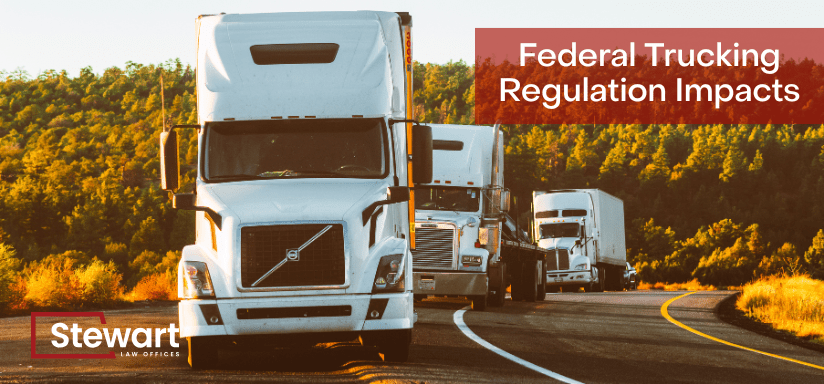
South Carolina truck drivers and trucking companies are subject to numerous regulations. These include federal regulations for truck drivers engaged in interstate commerce. The Federal Motor Carrier Safety Administration (FMCSA) is the primary agency responsible for enforcing these rules. Violations could make a trucker or trucking company liable for a crash.
The scale of the problem underscores why these regulations matter. According to FMCSA data, 5,375 large trucks were involved in fatal crashes across the United States in 2023, and large trucks account for a disproportionate share of fatal highway crashes relative to their numbers on the road. Every one of those crashes occurred within a regulatory framework designed to prevent them.
Understanding Federal Trucking Regulations
Vital regulations that South Carolina truck drivers and trucking companies must follow include those involving:
- Hours of Service – Federal Hours of Service rules govern how much time truck drivers can spend behind the wheel in a given day or week. For example, truck drivers carrying property can only drive for 11 hours a day and 60 or 70 hours a week (depending on the trucking company’s schedule).Drivers must take a 30-minute break after 8 consecutive hours of driving. HOS violations are particularly significant in injury claims because driver fatigue is a leading contributor to large truck crashes.
- CDL – A CDL is a Commercial Driver’s License. All commercial truck drivers must have one to legally drive a semi-truck or other commercial vehicle. While individual states set their own rules for obtaining a CDL, the FMCSA requires new drivers seeking their first CDL to go through Entry-Level Driver Training that meets specific standards.
- Maintenance – FMCSA guidelines govern certain maintenance and inspection requirements for truck drivers. For instance, federal truck regulations require companies to “systematically inspect, repair, and maintain” all the vehicles in their fleets. Another rule requires truck drivers to inspect their vehicles before every trip to make sure they are in “safe operating condition.”
- Cargo Securement and Loading – The FMCSA has established strict securement rules that truck drivers and cargo loaders must adhere to. Among other restrictions, tie-down devices must resist forces equal to 0.8 g in forward deceleration, 0.5 g in rearward acceleration, and 0.5 g in lateral acceleration. Improperly secured cargo can shift, fall, or change a truck’s center of gravity, leading to rollovers, jackknifes, or dangerous road debris.
- Drug and Alcohol Testing – FMCSA regulations mandate a comprehensive drug and alcohol testing program for all commercial drivers. This includes pre-employment testing, random testing during employment, post-accident testing, and reasonable-suspicion testing. A carrier that fails to conduct required testing, or knowingly retains a driver who has tested positive, may face significant liability if that driver is involved in a crash.
What Happens If a Truck Driver Violates FMCSA Trucking Regulations?
Violations of federal truck regulations by truck drivers or trucking companies that contribute to a crash can establish their legal liability. While these violations are typically not criminal, they can still lead to CDL suspensions and other penalties. More importantly for injured victims, a regulatory violation can establish negligence per se.
In truck accident claims, negligence means the truck driver or another party didn’t take reasonable steps to prevent a crash. Negligence per se means negligence “in itself” – that is, a violation of a safety standard is enough to establish a party’s negligence absent other facts.
For example, if a truck driver broke Hours of Service rules by driving for more than 11 hours in a single day. If the truck driver then caused a crash, the fact that they broke federal rules may be enough to prove their negligence and, subsequently, their liability for your injuries. This is why documentation, driver logs, ELD data, dispatch records, and black box data are critical to preserve immediately after a truck accident.
How Stewart Law Offices Can Help Strengthen Your Truck Accident Claim
The truck accident attorneys with Stewart Law Offices know the state and federal trucking regulations your case may involve and how to prove the defendant violated them. We will thoroughly review evidence such as driver logs, employment records, internal communications, and “black box” data to build your case and establish negligence per se.
Contact Our South Carolina Truck Accident Lawyers
Stewart Law Offices is committed to holding careless truckers and trucking companies accountable when they break the rules. Call now or complete our contact form for a free consultation with our South Carolina truck accident attorneys.