
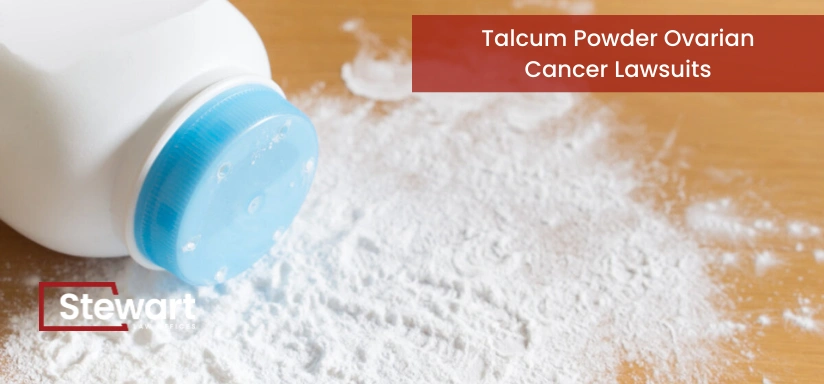
Talcum powder is a product made from talc, a mineral composed of magnesium, silicon, and oxygen. More commonly known as baby powder, it has been sold worldwide for decades. But while talcum powder has been popular for its drying properties and ability to prevent rashes, it has also been linked to ovarian cancer and mesothelioma.
As of January 2026, Johnson & Johnson faces over 67,580 talcum powder lawsuits in federal multidistrict litigation (MDL), making it the largest active MDL in the United States. These lawsuits allege that the company’s talc-based products caused ovarian cancer and mesothelioma in users. Talc is obtained from mines, some of which also contain asbestos, a known carcinogen.
In 2022, J&J announced it would stop selling talc-based products worldwide, completing the global discontinuation in 2023. The company has replaced talc with cornstarch in all of its powder products.
Were you diagnosed with ovarian cancer or mesothelioma after years of using talcum powder? If so, you could be entitled to compensation. Contact the talcum powder lawyers at Stewart Law Offices today for a free consultation. Our dedicated legal team has successfully represented injured people throughout South Carolina and North Carolina for over 30 years.
What is a Talcum Powder Lawsuit?
The talcum powder lawsuits currently pending against J&J allege that the company knew that its talc products had an increased risk of causing cancer in the reproductive system, but didn’t inform the public of the hazard.
Talc particles are microscopic. When applied to the genital area, it’s believed that the particles enter through the vagina and migrate through the fallopian tubes and uterus to the ovaries. Once there, the particles get lodged in the ovarian tissue. Over time, the talc irritates the tissues and causes DNA mutations, causing cancer.
The first lawsuit alleging a link between cancer and talcum powder was filed in 2013. Since that time, J&J has been ordered to pay billions of dollars to women and men who claimed the talcum powder caused their cancer.
Major Recent Developments (2024-2026)
The talcum powder litigation has seen extraordinary developments in recent years:
Record-Breaking Jury Verdicts
Recent jury verdicts demonstrate the legal system’s willingness to hold Johnson & Johnson accountable:
- December 22, 2025: Baltimore jury awards record-setting $1.5 billion to Maryland woman with peritoneal mesothelioma (approximately $59.8 million in compensatory damages, remainder in punitive damages)
- December 19, 2025: Minnesota jury awards $65.5 million to mother of three with pleural mesothelioma after finding J&J failed to warn about asbestos contamination
- December 16, 2025: California jury awards $40 million total to two women with ovarian cancer – $22 million to Debra Schulz and $18 million to Monica Kent in bellwether trial
- October 2025: Los Angeles jury awards $966 million to the family of Mae Moore, who died from mesothelioma in 2021 at age 88
- October 2025: Florida jury awards $20 million to the family of Dr. Alberto Casaretto, who died from mesothelioma after using baby powder for many years
In 2024 alone, Johnson & Johnson was ordered to pay $320 million in mesothelioma lawsuit verdicts. In 2025, mesothelioma verdicts exceeded $2.5 billion.
Current Status of Litigation (February 2026)
The talcum powder litigation continues to move forward aggressively across multiple jurisdictions:
Federal Multidistrict Litigation (MDL 2738)
- Over 67,000 lawsuits are pending in the U.S. District Court of New Jersey under Judge Michael A. Shipp
- New lawsuits continue to be filed at a rate of hundreds to thousands per month
- January 2026: MDL increased by 9,375 cases from 2025
- First federal bellwether trial: Judkins v. Johnson & Johnson, involving New Hampshire woman Carter Judkins with ovarian cancer
- Court-appointed lead negotiation counsel overseeing settlement talks, with formal mediation sessions underway
State Court Actions
- Philadelphia Court of Common Pleas: New mass tort program established with 26+ cases, two bellwether trials scheduled for early 2026
- California Judicial Council Coordinated Proceedings (JCCP): Ongoing trials in Los Angeles Superior Court, with Judge Theresa Traber selecting six cases to be tried in pairs
- Multiple state court bellwether trials are scheduled throughout 2026
What’s Next?
- More bellwether trials expected throughout 2026 to help shape settlement negotiations
- Federal MDL expected to continue with expert testimony and scientific evidence evaluations
- J&J has reportedly set aside $11 billion to resolve all talc lawsuits
- Approximately 90,000 victims, mostly women with ovarian cancer, are still pursuing claims
According to Reuters, talc lawsuits against J&J were identified as one of the top mass tort litigations to watch in 2026, with ovarian cancer claims expected to accelerate following the failed bankruptcy attempts.
Proving Fault in a Talcum Powder Lawsuit
Cases involving talcum powder are complex. An experienced defective products attorney can help determine whether you have a case.
To win a talcum powder lawsuit, you will need to provide convincing evidence that the product caused your cancer. Factors that must be considered include:
- Was your baby powder made from talc? J&J also sells a cornstarch-based form of baby powder.
- How long did you use talcum powder? Cancer develops slowly. If you only used talcum powder sporadically, it will be much harder to prove that it caused your cancer compared to a woman who used it daily for 30 years.
- Do you have ovarian cancer? Medical records can establish a diagnosis of the disease. Other cancers potentially linked to talc exposure include fallopian tube cancer and peritoneal mesothelioma.
- Did you use talcum powder made by other manufacturers? J&J is not the only maker of talcum powder products. Other defendants in talc litigation include:
- Avon Products Inc.
- Chanel
- Colgate-Palmolive
- Revlon
- Imerys Talc America (talc supplier)
- Cyprus Mines
- If you used drugstore-brand baby powder or other talc-based powders along with J&J’s, it could be challenging to definitively show that one particular manufacturer is to blame for your cancer. However, experienced attorneys can help identify all potentially liable parties.
- Did talcum powder cause your ovarian cancer? This will be the biggest hurdle to overcome. Many studies have pointed to a connection between talc and cancer. Other research has discounted these findings. The International Agency of Research on Cancer (IARC) has classified talcum powder as a probable carcinogen to humans (Group 2A), the second-highest level of certainty that a substance can cause cancer. To win your case, your talcum powder lawyer will need to show that your baby powder use more likely than not caused your ovarian cancer.
States have different statutes of limitations, or deadlines, for when a talcum powder lawsuit must be filed. Our lawyers can help determine the statute of limitations in your case and whether you have a valid compensation claim.
Not Sure If You Have a Talcum Powder Lawsuit? Contact Us Today
For more information about talcum powder lawsuits in North Carolina and South Carolina, call Stewart Law Offices today for a free consultation. With six offices throughout the Carolinas, our compassionate personal injury attorneys can meet with you wherever is most convenient for you.
Contact us now to get started.
Note: Talcum powder litigation is rapidly evolving. This article reflects the state of the litigation and scientific evidence as of January 2026. For the most current information about your specific case, please consult with an attorney. New cases are still being filed and accepted.