
Lexington Jackknife Truck Accident Lawyer
Legally Reviewed by the Stewart Law Offices Content Team: Sep 19, 2026
When a tractor-trailer jackknifes on an interstate or state highway, the trailer swings violently across multiple lanes of traffic in a fraction of a second. Drivers sharing the road have almost no warning and no safe path of escape. The result is frequently catastrophic, multi-vehicle pileups, rollovers, and collisions of such severity that the occupants of passenger vehicles rarely walk away uninjured. If you or a loved one was hurt in a jackknife truck crash anywhere in Lexington County, Stewart Law Offices is ready to fight for the full compensation you deserve.
 Attorney Stephen Vicari is a licensed member of the South Carolina Bar with more than 10 years of experience standing up for truck accident victims across Lexington County. When you choose Stewart Law Offices, you deal directly with your attorney throughout the entire process, not a rotating team of case managers. You receive clear communication, honest answers, and committed advocacy from the first call through the final resolution. Whether your crash occurred on I-20 near the Lexington town center, on US-378 heading toward Batesburg-Leesville, or on SC-6 through Gaston, our legal team is prepared to investigate immediately and pursue all liable parties.
What Is a Jackknife Accident?
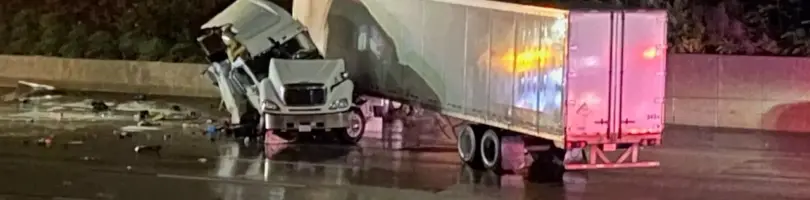
A jackknife accident occurs when a tractor-trailer’s cab and trailer fold inward toward each other at the point of connection, the fifth wheel coupling, forming an angle resembling a folding pocketknife. The physics behind it are unforgiving: a fully loaded 18-wheeler can weigh up to 80,000 pounds, and when sudden braking causes the cab to slow while the trailer’s momentum continues forward, the trailer pivots sideways at highway speed. The result is a wall of steel sweeping across multiple lanes.
Unlike most crashes that involve two discrete vehicles, a jackknifed truck becomes an obstacle spanning the entire roadway. Drivers in adjacent lanes, drivers approaching from behind, and sometimes drivers in oncoming traffic all face simultaneous, unavoidable danger. Secondary collisions, cars slamming into the trailer or each other while trying to evade it, are common and often cause additional serious injuries beyond the initial impact. Nationally, jackknife truck accidents contributed to 142 fatal crashes in the most recently analyzed NHTSA/FMCSA dataset, representing approximately 2.4 percent of all fatal large truck crashes. While that percentage may appear modest, it translates to more than two fatal jackknife crashes every single week across the country.
Jackknife accidents differ legally from other truck accidents in important ways, too. The physics of the event, the driver’s response time, the trailer’s loaded weight, road and weather conditions, and the mechanical condition of the braking system all factor into liability, making expert investigation and evidence preservation essential from the very first day.
What Causes a Jackknife Accident?
A jackknife does not happen without a reason, and that reason, when it involves driver error, equipment failure, or trucking company negligence, is the foundation of your legal claim. The most common causes our Lexington jackknife accident lawyers investigate include:
- Sudden or Improper Braking: When a truck driver applies the brakes too forcefully or too suddenly, the cab decelerates faster than the trailer. The differential momentum causes the trailer to skid sideways. Panic stops, tailgating, and inadequate following distance make this scenario more likely and more foreseeable. Commercial drivers are specifically trained to avoid this response, making a jackknife from abrupt braking evidence of inadequate skill or fatigued reaction time.
- Excessive Speed: Speed dramatically reduces a driver’s reaction time and increases the energy that must be absorbed when braking. On I-20 near Lexington, where speed limits reach 70 mph, and freight trucks run around the clock, a driver who was exceeding safe speeds for road conditions when a hazard appeared has little chance of stopping cleanly. Federal regulations require drivers to reduce speed to conditions, a rule regularly violated on Lexington’s busy freight corridors.
- Slippery Road Surfaces: Rain, morning fog, and occasional winter icing create traction-loss conditions that loaded trailers cannot safely handle at highway speeds. A driver who fails to reduce speed for wet or compromised road surfaces bears responsibility for any resulting jackknife.
- Brake System Failures and Deferred Maintenance: Federal regulations under 49 CFR Part 396 require pre-trip and post-trip inspections and mandate that defects be repaired before a vehicle returns to service. When a trucking company allows a vehicle with known brake deficiencies to continue operating, the company bears direct liability for any resulting crash.
- Driver Fatigue: Hours-of-service violations under 49 CFR Part 395 are among the most common contributing factors in serious jackknife crashes. A fatigued driver’s reaction time degrades; their ability to recognize a developing road hazard and modulate braking appropriately is severely compromised. ELD data frequently reveals violations that occurred in the hours leading up to a crash.
- Improper Cargo Loading: Federal cargo securement requirements under 49 CFR Part 393 govern how freight must be distributed and secured. An improperly loaded or shifted cargo load changes the trailer’s center of gravity and weight distribution in ways that make a jackknife far more likely, even during braking, than a properly loaded truck could safely manage.
- Sharp Curves Without Speed Reduction: Drivers negotiating curves on two-lane Lexington County roads must reduce speed to maintain control of a trailer. A driver who enters a curve at highway speed without proper deceleration creates exactly the lateral forces that cause a jackknife.
- Distracted Driving: A driver whose eyes leave the road to check a GPS, read a message, or adjust an in-cab screen is not monitoring developing road conditions and cannot anticipate or respond to a hazard in time to brake appropriately.
How Jackknife Accidents Are Different From Other Truck Crashes
Most truck accidents involve a collision between the truck and another vehicle. A jackknife accident is different in a critical way: the truck becomes an obstacle that other vehicles cannot avoid, and the secondary collisions it generates may injure victims who were not even in proximity to the initial triggering event. This has direct legal implications:
- Multiple potential defendants. A jackknife event may involve the truck driver, the trucking company, the cargo loader, the maintenance contractor, and even the manufacturer of defective braking components, all simultaneously. Each represents a separate source of liability and a separate insurance policy.
- Complex evidence. The black box (Event Data Recorder) captures speed, braking force, and steering inputs in the seconds leading up to the event. ELD records show hours-of-service compliance for the days preceding the crash. Maintenance logs document whether known defects were repaired. Cargo manifests and loading records show how the trailer was packed. All of this evidence has a limited preservation window, and a formal legal hold letter must go out immediately to prevent destruction.
- Catastrophic injury patterns. Because the trailer sweeps across multiple lanes, occupants of passenger vehicles are typically struck at angles for which they have no protective structure. Underride collisions, where a passenger vehicle slides beneath the trailer, are among the most lethal accident types on American roads and frequently follow a jackknife event.
- Insurance complexity. Commercial trucking carriers hold policies ranging from $750,000 to $5 million or more per accident. These insurers deploy their own investigators and legal teams within hours. Matching that response requires a Lexington jackknife accident lawyer who is already moving on the same timeline.
Who Can Be Held Liable for a Lexington Jackknife Accident?
South Carolina’s modified comparative negligence rule under SC Code § 15-38-15 allows victims to recover compensation as long as they are found less than 51% at fault. For jackknife accident victims, who typically had no opportunity to avoid the crash, fault attribution rarely presents an obstacle. The more important question is identifying every party whose negligence contributed, because each one represents a potential source of compensation.
Potentially liable parties in a Lexington jackknife accident case include:
- The truck driver for the specific act of negligence that triggered the jackknife: improper braking, excessive speed, distracted driving, or fatigued operation
- The trucking company for negligent hiring, inadequate driver training, pressure to drive through required rest periods, failure to maintain vehicles, or creating operational incentives that foreseeably cause dangerous driving
- The cargo loading company, when improper load distribution or unsecured freight contributed to the trailer’s loss of control
- A third-party maintenance contractor, when outsourced maintenance failed to address known brake or tire defects before the truck returned to service
- A parts manufacturer, when a defective brake component, tire, or coupling mechanism failed during normal operation
- A government entity, when a dangerously designed road, missing warning signage, or inadequate safety infrastructure on a Lexington County roadway contributed to the crash, is subject to the SC Tort Claims Act’s two-year deadline and notice requirements.
Injuries Commonly Caused by Jackknife Accidents
Because a jackknifed trailer sweeps across multiple lanes and incoming vehicles strike it broadside often without any opportunity to brake, the injuries in these crashes are among the most devastating our attorneys handle:
- Traumatic brain injuries, including diffuse axonal injury and subdural hematomas
- Spinal cord injuries produce partial or complete paralysis
- Multiple bone fractures, including compound fractures requiring surgical reconstruction
- Internal organ damage and hemorrhage requiring emergency surgery
- Crush injuries, amputations, and severe degloving from underride collisions
- Severe burns when fuel tanks rupture during a jackknife-triggered rollover
- Post-traumatic stress disorder and other long-term psychological injuries
- Wrongful death occurs when occupants of struck vehicles do not survive the impact
Under SC Code § 15-51-10, surviving family members have the right to pursue a wrongful death claim within three years of the date of death. Both wrongful death and a companion survival action may be filed, covering all damages the deceased would have been entitled to personally.
Compensation Available After a Lexington Jackknife Accident
South Carolina law allows jackknife accident victims to pursue the full scope of damages caused by a trucking company’s or driver’s negligence. A thorough claim covers:
- Economic damages — Emergency medical care, surgery, hospitalization, rehabilitation, ongoing specialist care, prescription medications, medical equipment and assistive devices, home modifications, lost wages during recovery, and projected future earning capacity loss
- Non-economic damages — Physical pain and suffering, emotional distress and PTSD, loss of enjoyment of life, permanent scarring or disfigurement, and loss of consortium
- Punitive damages — Available when the trucking company’s conduct was especially reckless, such as knowingly allowing a driver to operate in violation of hours-of-service rules or permitting a vehicle with documented brake defects to continue in service. Under SC Code § 15-32-530, punitive damages are capped at three times compensatory damages or $500,000, whichever is greater, with exceptions for alcohol or drug impairment by the defendant.
Our attorneys work with medical specialists, life care planners, and vocational economists to calculate the complete current and future value of your claim before any settlement discussions begin, because settling too early, before all future costs are projected, means accepting compensation that will run out long before your needs do.
The Statute of Limitations for Lexington Jackknife Accident Claims
Under SC Code § 15-3-530, you have three years from the date of the jackknife accident to file a personal injury lawsuit. For wrongful death cases, the three-year clock begins on the date of the victim’s death.
The trucking company’s legal team begins its defense within hours of a crash. Contacting a Lexington truck accident attorney on the same day, or as close to it as possible, is the single most important step to protecting your evidence and your rights.
Visit Our Lexington Jackknife Accident Lawyers in Lexington, SC
Contact Our Lexington Jackknife Accident Lawyers
If you were injured or lost a loved one in a jackknife truck accident anywhere in Lexington County, Stewart Law Offices is ready to pursue every liable party and every dollar of compensation the law provides.
Frequently Asked Questions About Lexington Jackknife Accident Lawyers
A jackknifed trailer becomes a moving wall blocking multiple traffic lanes simultaneously. Drivers in adjacent lanes, approaching from behind, and sometimes in oncoming traffic, have fractions of a second to react, which is rarely enough. Secondary collisions between passenger vehicles trying to evade the trailer are common, and underride collisions, where a car slides beneath the trailer, are among the most lethal outcomes in any road crash. The simultaneous exposure of multiple vehicles to a single, unpredictable 80,000-pound obstacle makes these events uniquely devastating.
The most critical truck-specific evidence includes the Event Data Recorder (black box) capturing speed, braking force, and steering inputs in the seconds before impact; ELD logs documenting hours-of-service compliance in the days before the crash; dashcam footage from the cab; maintenance and inspection logs for the specific truck and trailer; and drug and alcohol test results taken post-accident. Black box data is often overwritten within 30 days. Dashcam footage within 24 to 72 hours. Our attorneys send formal spoliation letters on the day we are retained to prevent any of this evidence from being lost.
Yes, in many cases. South Carolina courts and federal FMCSA regulations recognize that trucking companies can be vicariously liable for independent contractors when the company controlled how the driver operated, required the driver to carry the company’s USDOT number, or set schedules and routes. The “independent contractor” classification is often used to deflect liability, but courts look at the actual working relationship rather than the contractual label. Our attorneys investigate the true nature of the arrangement and, when the evidence supports it, pursue the carrier directly.
Under SC Code § 15-51-10, surviving family members, typically a spouse, children, or parents, may file a wrongful death lawsuit within three years of the date of death. Recoverable damages include all medical expenses before death, funeral and burial costs, the deceased’s projected lifetime earnings, loss of companionship and consortium, and punitive damages when the trucker or carrier’s conduct was especially reckless. A companion survival action, filed by the estate, covers damages the victim would have been entitled to personally. Both claims are pursued together to maximize the family’s total recovery.