
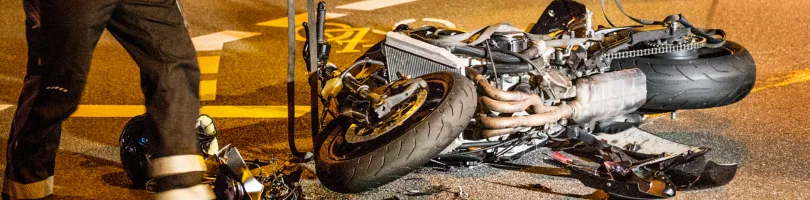
What Should I Do After A Motorcycle Accident in Lexington?
Legally Reviewed by the Stewart Law Offices Content Team: Sep 20, 2026
A motorcycle accident happens in seconds, but the decisions you make in the hours and days that follow can affect the outcome of your recovery, physically, financially, and legally, for years. Knowing exactly what to do after a motorcycle accident in Lexington County is the difference between a strong legal claim and one that is undermined by early mistakes that cannot be undone.
 Attorney Stephen Vicari has spent more than a decade representing injured motorcyclists throughout Lexington County as a licensed member of the South Carolina Bar, fighting for full compensation against insurance companies that would rather pay as little as possible. At Stewart Law Offices, you are treated as an individual, not a file number. You speak directly with your attorney from day one, receive honest guidance at every stage, and have an experienced advocate in your corner from your very first conversation.
What To Do After a South Carolina Motorcycle Accident
South Carolina is one of the most dangerous states in the country for motorcycle riders. SCDPS recorded 161 motorcyclist fatalities in 2021, averaging one rider death every three days. Preliminary figures for 2020 documented 116 motorcyclist deaths, showing only a slight decrease from prior years. What you do in the minutes and hours after a motorcycle crash in South Carolina can shape both your medical recovery and any future injury claim. Even on familiar roads, riders are often dazed, in pain, and overwhelmed, which makes it easy to miss important steps.
Having a simple plan before you ride can help you stay safe, preserve crucial evidence, and avoid mistakes insurance companies might later use against you.
Step 1: Assess Your Surroundings and Get to Safety
The first thing to do after a motorcycle accident is to stay calm and assess your immediate situation. First, evaluate whether staying where you are puts you at risk of a secondary collision with oncoming traffic.
If you are physically able, move yourself and your motorcycle to the side of the road or the shoulder, out of active traffic lanes. Do not remove your helmet or other protective gear until emergency medical personnel arrive and assess you. In a crash, cervical spine injuries may not be immediately apparent, and removing a helmet improperly can cause or worsen neurological damage.
If your injuries prevent you from moving, stay still and signal for help from bystanders. Ask others to block traffic or activate hazard flashers on nearby vehicles to protect the scene until emergency responders arrive.
Step 2: Contact Law Enforcement
Call 911 immediately. Many motorcyclists underestimate this step because adrenaline suppresses pain and masks the symptoms of serious injury in the immediate aftermath of a crash. Internal bleeding, concussions, traumatic brain injuries, and spinal cord injuries can all develop silently before producing obvious symptoms.
When you call 911:
- Tell the dispatcher your location as precisely as possible; include the road name, nearest intersection or mile marker, and direction of travel
- Confirm whether anyone is injured and whether emergency medical services are needed
- Stay on the line until the dispatcher releases you
The responding law enforcement officer will document the crash, gather witness information, note road and weather conditions, and issue any citations to the at-fault driver, creating official documentation critical for Lexington County injury claims. That police report becomes one of the foundational documents in your injury claim.
Step 3: Seek Medical Attention Immediately
Getting medical attention the same day as the crash is crucial for your health and legal claim. Motorcycle accidents can cause hidden injuries like concussions, internal bleeding, or nerve damage that may not show symptoms immediately. Delaying treatment increases medical risks and gives insurance companies ammo to downplay your injuries.
A same-day medical record creates a clear link between the crash and your condition, strengthening your claim. Lexington County riders should seek treatment at the nearest trauma facility to establish the injury timeline. Follow through on all recommended appointments and treatments to build a solid evidentiary record.
Step 4: Gather Evidence at the Scene
If you are physically able and it is safe to move around, gathering information at the scene can be extremely valuable. Try to:
- Take photos of all vehicles, your motorcycle, road conditions, skid marks, and visible injuries
- Photograph traffic signals, signs, and any debris or hazards
- Get names and contact details for witnesses and other drivers
- Note the other driver’s license plate, insurance information, and apparent injuries
A Lexington Motorcycle Accident Lawyer recommends collecting as much evidence as possible before vehicles are moved or the scene is cleaned up, because these details may later show how the crash happened.
Step 5: Get the Other Driver’s Information
Exchange information with every driver involved in the crash. Under South Carolina law, drivers involved in collisions are required to provide their name, address, and vehicle registration information to other parties involved. Collect:
- Full legal name and home address
- Driver’s license number and state of issue
- Vehicle registration and license plate number
- Insurance company name, policy number, and claims phone number
- Contact number for the driver
Do not rely solely on what the at-fault driver volunteers. Verify their insurance information against the physical insurance card if possible. If the at-fault driver is operating a commercial vehicle, record the company name, DOT number visible on the vehicle, and any identifying vehicle or trailer numbers.
Step 6: Identify and Talk to Witnesses
Witness testimony is crucial in motorcycle accident cases, especially in Lexington, where insurers often try to shift blame under the modified comparative negligence rule. If people saw the crash, approach them quickly for their full name, contact information, and a brief description of what they observed.
Independent witnesses are especially valuable because they cannot be accused of bias. Prompt statements preserve accurate details before memories fade, often becoming decisive evidence when liability is disputed.
Step 7: Report to Your Insurance Company
South Carolina law requires that you report accidents to your own insurance company in a timely manner. Contact your insurer to report the crash as required by your policy.
However, keep this initial notification strictly factual, including the date, location, and fact of the collision. Do not provide a detailed account of how the accident happened. Do not speculate about fault. Do not describe your injuries in detail or characterize their severity. Do not make any recorded statement until you have spoken with a motorcycle accident attorney.
Your own insurer, despite representing you, has financial interests that are not perfectly aligned with yours, particularly in cases where uninsured motorist (UM) coverage, underinsured motorist (UIM) coverage, or medical payments (MedPay) coverage is at issue.
Step 8: Do Not Speak to the At-Fault Driver’s Insurance Company
This is the step that trips up the most motorcycle accident victims, and the one that causes the most irreparable harm to otherwise strong claims.
The at-fault driver’s insurance company will contact you quickly, sometimes within hours of the crash. The adjuster will be friendly, express concern about your well-being, and ask to take a “brief recorded statement.” Do not agree to this before speaking with an attorney.
Insurance adjusters are professionally trained to ask questions in ways designed to elicit statements that minimize your injuries, suggest that you contributed to the crash, or create inconsistencies with your later medical records. Under South Carolina’s modified comparative negligence rule codified in SC Code § 15-38-15, a statement that allows the insurer to assign you 51% or more of fault eliminates your recovery. A statement that assigns you even partial fault reduces your compensation proportionally.
You have no legal obligation to give any statement to the other driver’s insurer before retaining legal counsel. Tell them you have been in an accident, that you are seeking medical attention, and that your Lexington motorcycle accident lawyer will be in contact.
Step 9: Preserve All Evidence
Beyond the crash scene, evidence begins to deteriorate quickly after a motorcycle accident. While attorneys take formal steps, you can act immediately. Keep your clothing and gear unwashed in a sealed bag since damage patterns may help reconstruct the crash. Save all medical records and bills in a folder to establish injuries and costs.
Maintain a daily journal of pain and limitations to document non‑economic damages. Avoid posting on social media because insurers often monitor profiles to dispute claims.
Step 10: Do Not Settle Too Quickly
Insurance companies consistently offer initial settlements that are far below the true value of a motorcycle accident claim. These early offers arrive before the full extent of your injuries is known, before future medical costs can be projected, and before lost earning capacity is calculated. Accepting a quick settlement is a permanent decision; once signed, you surrender all rights to any additional compensation, regardless of how your condition develops.
Do not accept any settlement, sign any release, or agree to any payment arrangement before consulting with a Lexington motorcycle accident attorney who can evaluate whether the offer reflects the full scope of your current and future losses.
Step 12: Contact a Lexington County Motorcycle Accident Lawyer
The final and most consequential step after a motorcycle accident in South Carolina is contacting an experienced Lexington motorcycle accident attorney as early as possible. The legal process, identifying all liable parties, sending evidence preservation demands, handling insurance communications, calculating full lifetime damages, and building a case for trial, begins from day one.
Every day that passes without legal representation is a day that the at-fault driver’s insurer is working against your interests.
Visit Our Motorcycle Accident Attorneys in Lexington, SC
What Compensation Can a Motorcycle Accident Victim Recover in South Carolina?
South Carolina law allows injured motorcyclists to pursue compensation for the full scope of harm a negligent driver’s actions caused:
- Economic damages: Emergency medical care, surgery, hospitalization, rehabilitation, future medical treatment, prescription medications, adaptive equipment, lost wages during recovery, and reduced future earning capacity if injuries permanently affect your ability to work
- Non-economic damages: Physical pain and suffering, emotional distress and PTSD, loss of enjoyment of life, permanent scarring or disfigurement, and loss of consortium
- Punitive damages: Available when the at-fault driver’s conduct was especially reckless, such as drunk driving. Under SC Code § 15-32-530, punitive damages are capped at three times compensatory damages or $500,000, whichever is greater, with exceptions for alcohol or drug impairment
At Stewart Law Offices, Attorney Stephen Vicari handles every aspect of your Lexington County motorcycle accident case personally. We investigate the crash, identify every liable party, handle all communications with insurers, and pursue the maximum compensation the law allows, on a contingency fee basis, meaning no attorney fees unless we recover for you.
Frequently Asked Questions
A police report creates an official, contemporaneous record of the crash that insurance companies and courts rely on. Without it, the at-fault driver can later deny causing the crash, minimize the collision, or claim you agreed to waive your rights by settling on the spot. South Carolina Code § 56-5-1260 requires that accidents involving injury or significant property damage be reported to law enforcement. Any agreement made at the scene without a police report and legal counsel is unenforceable and should never be accepted. Insurance defense teams routinely monitor every accessible social media profile of a claimant throughout the life of a claim. A photograph at a family gathering, a comment about “starting to feel better,” or a video of any physical activity, however innocent, can be taken out of context and presented to a jury or adjuster as evidence that injuries were exaggerated or fabricated. Even posts by friends tagging you at locations can create problems. Our attorneys advise all clients to suspend all social media activity from the day of the accident through the final resolution of the case. Under SC Code § 15-3-530, the standard deadline is three years from the date of the accident. However, if the at-fault party was a government entity, such as an SCDOT vehicle or a county fleet car, the SC Tort Claims Act’s two-year deadline and advance written notice requirements apply. Missing either the notice deadline or the two-year filing period permanently bars the claim. For wrongful death cases, the three-year clock runs from the date of death rather than the accident date. Contacting an attorney immediately eliminates any risk of missing these deadlines. The physical condition of the motorcycle after a crash documents the mechanics of the collision. Crash damage patterns reveal the angle and point of impact, tire condition indicates whether brake lockup occurred, mechanical defects may point to a product liability issue, and debris embedded in the frame can establish the direction of force. Repairing the motorcycle before documentation permanently destroys this evidence. Your Lexington motorcycle accident attorney can commission an independent inspection and expert analysis of the preserved physical condition, an analysis that can be decisive in disputed liability cases.