
Drivers across the Carolinas may have noticed Drivers across the Carolinas may have noticed an increase in roundabouts at road or highway intersections. Roundabouts offer numerous safety advantages over traditional intersections, but they can be confusing and challenging for motorists who’ve never driven them.
What Is a Roundabout – And Is It Safe?
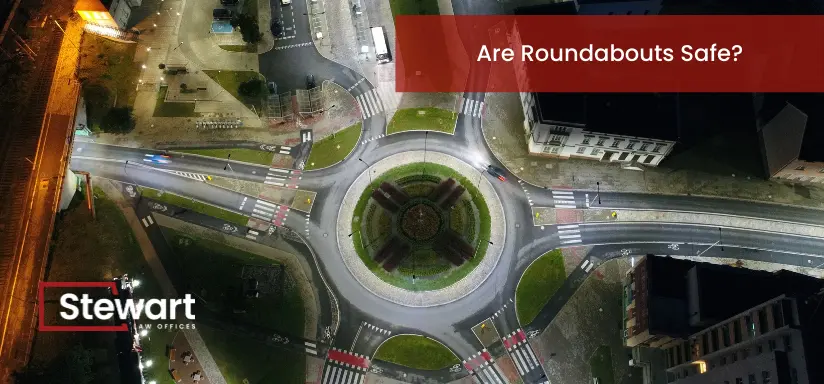
A roundabout includes a circular roadway surrounding a raised center island or median. Vehicles enter the roundabout and travel around the center island or median, exiting the roundabout onto their desired street.
In some cases, traffic signals control entry into a roundabout, though most operate under standard traffic laws governing right-of-way. For example, in the Carolinas, vehicles must yield to traffic already in the roundabout. Some people also call roundabouts rotaries or traffic circles, although others use those terms to refer to road features larger or smaller than roundabouts.
A roundabout is designed to facilitate traffic flow between intersection streets or highways. They were first developed in the United Kingdom and are more commonly found in Europe. However, roundabouts have gained increasing popularity in the United States over the past few decades. Some states have adopted traffic design preferences for roundabouts in road redesigns or new constructions.
Although roundabouts may seem less safe because they often lack traffic signals to control vehicular movement, multiple studies have found that roundabouts increase traffic safety. The U.S. Department of Transportation has found that single-lane roundabouts perform better than two-way stop-controlled intersections. When accidents do occur in roundabouts, they have lower injury rates. One study of eleven intersections in the U.S. converted to roundabouts found that crash rates dipped from 9.3 accidents per intersection to 5.9, with injury crashes reducing by half.
Benefits of a Roundabout
Roundabouts have several safety benefits over traditional signed or signaled intersections. Some of the reasons why roundabouts offer greater safety than traditional intersections include:
- Roundabouts have fewer conflict points than conventional intersections.
- The circular geometry of a roundabout naturally slows drivers to between 15 and 25 mph, giving them more time to react to hazards and substantially reducing both the likelihood and severity of a crash.
- Roundabouts often have lower pedestrian accident rates since pedestrians only need to cross one direction of traffic at a time as they reach a corner or island.
- Roundabouts also deliver environmental and efficiency benefits. Studies show they can reduce vehicle delays by up to 89%, cut carbon monoxide emissions by 15% to 45%, and reduce fuel consumption by an estimated 23% to 34% compared to traditional signalized intersections.
Road Rules to Keep in Mind
Although increasing in popularity in the U.S., many parts of the country lack roundabouts. However, all motorists should familiarize themselves with the rules of the road for roundabouts, which include the following:
- Look to the left as you approach the stop or yield line at the edge of the roundabout.
- Yield to traffic in the roundabout and look out for pedestrians in the crosswalk.
- Enter the roundabout when you see a gap in traffic and travel around the center circle to your exit, again looking for crossing pedestrians as you reach your exit.
- When approaching multi-lane roundabouts, it is crucial to select the correct lane before entering. Use the right lane if you plan to turn right, and the left lane for all other directions. Choosing your lane early is essential, as changing lanes within the roundabout is hazardous and frequently leads to sideswipe collisions.
Contact an Auto Accident Attorney
If you’ve had an accident in a roundabout due to another driver’s negligence, a Carolina car accident lawyer from Stewart Law Offices can help you pursue compensation. Contact our firm today for a free no-obligation consultation with an auto accident attorney to learn more about your legal options.