
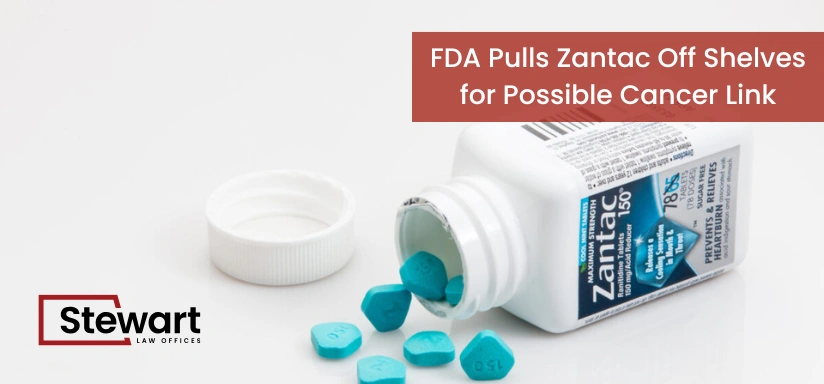
The U.S. Food and Drug Administration (FDA) has ordered the popular heartburn medication ranitidine (brand name Zantac) to be taken off the market immediately. The decision was made due to the discovery that ranitidine drugs may contain dangerous levels of N-Nitrosodimethylamine (NDMA), a probable human carcinogen.
The recall affects both prescription and over-the-counter (OTC) ranitidine medications. Hundreds of Zantac lawsuits are already pending throughout the United States, alleging that the drugmakers failed to warn the public of the dangers of NDMA and that their inaction led to diagnoses of cancer in some consumers. If you or a family member took Zantac or a generic ranitidine product, you may have a case for compensation. The experienced personal injury attorneys at Stewart Law Offices can evaluate your case in a free consultation.
With Six locations in South Carolina and North Carolina, our lawyers can meet with you wherever you are most comfortable.
Call or contact us today to schedule a free consultation.
2024-2025 Zantac Lawsuit Updates
Since the 2020 recall, Zantac litigation has experienced significant developments. In October 2024, GlaxoSmithKline announced a landmark settlement of up to $2.2 billion to resolve approximately 80,000 state court lawsuits, covering about 93% of pending claims. This followed earlier settlements by Sanofi ($100 million for 4,000 cases) and Pfizer ($250 million for 10,000 cases) in 2024. Boehringer Ingelheim has not participated in settlements and continues to defend cases at trial.
The legal landscape remains challenging for plaintiffs. In December 2022, a federal judge dismissed the multidistrict litigation (MDL) after ruling that plaintiffs’ expert witnesses could not reliably prove that ranitidine causes cancer. This decision affected thousands of federal cases and is currently on appeal to the 11th Circuit Court of Appeals.
State courts initially provided more favorable rulings. However, in July 2025, the Delaware Supreme Court reversed a lower court decision, excluding plaintiffs’ expert testimony in approximately 75,000 Delaware cases. Despite these setbacks, trials continue in California and Illinois, though juries have not yet ruled in favor of plaintiffs in any completed trials. New lawsuits continue to be filed as individuals who used Zantac for years are only now being diagnosed with cancer.
What Makes Zantac Dangerous?
According to a press release, the FDA’s decision was based on testing that showed NDMA levels in some ranitidine medications increased to unacceptable levels over time, particularly when stored at higher than room temperatures. However, increases in NDMA levels were also observed when the drugs were stored at normal temperatures as well.
NDMA has been linked to primary cancers of the:
- Stomach
- Bladder
- Small intestine
- Colon/rectum
- Esophagus
- Liver
On a lesser level, NDMA has possible associations with:
- Early-onset prostate cancer
- Pancreatic cancer
- Non-Hodgkin’s lymphoma
- Multiple myeloma
No one should have to live with a life-threatening disease caused by someone else’s negligence — particularly a pharmaceutical company, whose main job is to make drugs to improve public health. If you believe you’ve been harmed, speaking with a Rock Hill personal injury lawyer can help you understand your options.
Can I Sue for Damages?
Zantac lawsuits are already underway. However, the legal landscape has become more challenging following federal court rulings and multiple defense verdicts. To determine if you have a case, you will need to meet with a knowledgeable attorney with experience handling defective drug claims.
Several steps must be taken to decide if you may be entitled to compensation:
- Did you take Zantac or ranitidine? This can be established through medical records, prescription receipts, or statements from a doctor, even if you only took the OTC version of the drug.
- How long did you take the drug? If you only took the medication for a short period, it will be more difficult to prove a connection between Zantac use and your cancer diagnosis. Generally, stronger cases involve individuals who took ranitidine regularly for several years or more.
- Do you have cancer? Proof of diagnosis can be confirmed through medical records. Cases involving bladder, stomach, liver, pancreatic, and esophageal cancers have the strongest scientific support.
- Did Zantac cause your cancer? Here is the trickiest part of your case. Your attorney will need to provide compelling evidence to show that your Zantac use and cancer diagnosis are closely connected. For example, if you took Zantac for three years for acid reflux, you will likely have a stronger case than someone who used it for six months. There is also a latency period (the time between exposure to a cancer-causing substance and the development of the disease) to consider. If you took Zantac for six months and were diagnosed with cancer a month later, it will be more difficult to convince a judge or jury that ranitidine caused the disease.
Compensation in dangerous drug cases can help cover medical costs, lost income, lost earning potential, pain and suffering, and other losses stemming from the diagnosis. This money can be vitally important to keep families afloat during a cancer battle.
Diagnosed with Cancer After Taking Zantac? Learn Your Legal Rights Now
Call or contact Stewart Law Offices today for more information about Zantac lawsuits. Our North Carolina and South Carolina injury lawyers are standing by to help.