
Columbia Pedestrian Accident Lawyer
Legally Reviewed by Brent Stewart: June 09, 2026
Pedestrian accidents are some of the most devastating incidents on our roads. Without the protection of a vehicle, pedestrians are vulnerable to serious injuries that can change their lives forever. These accidents often lead to overwhelming medical bills, lost wages, and long‑term recovery needs.
If you or someone close to you was struck by a vehicle while on foot in Columbia or anywhere in Richland County, you are dealing with consequences that can be physical, financial, and deeply personal all at once. The legal process of holding the responsible driver accountable and recovering compensation that actually covers what this injury has cost you demands an attorney with both the skill and the genuine commitment to see it through.
 At Stewart Law Offices, we represent individuals and families across Columbia and Richland County who have been injured in pedestrian accidents. Our legal team includes Brent Stewart, a South Carolina Bar–licensed attorney with decades of experience advocating for injury victims. He works closely with clients to pursue accountability and meaningful financial recovery, guiding each step of the legal process. For many Columbia residents, having a knowledgeable and supportive legal team can make a critical difference during recovery.
If you have been injured while walking, a Columbia Pedestrian Accident Lawyer at Stewart Law Offices can help you understand your legal rights and take action.
How South Carolina Law Governs Pedestrian Accident Claims
In 2023, pedestrian fatalities accounted for 18 percent of all traffic fatalities nationwide. That year, an estimated 68,244 pedestrians were injured in traffic crashes across the United States, and a staggering 7,314 were killed, according to the NHTSA’s 2023 Traffic Safety Facts for Pedestrians.
Understanding the legal framework that applies to your Columbia pedestrian accident case is essential because South Carolina has specific rules that affect how fault is assigned and whether you can recover at all.
South Carolina Is an At-Fault State
South Carolina operates under a tort liability system. The driver who caused the crash is legally and financially responsible for the injuries. As an injured pedestrian, you have the right to file a claim against the at-fault driver’s liability insurance and to sue them directly if the claim cannot be resolved fairly.
Modified Comparative Fault Applies
South Carolina follows a modified comparative fault rule under S.C. Code § 15-38-15. Your compensation can be reduced in proportion to any share of fault attributed to you. However, if your share of fault reaches 51 percent or more, you are completely barred from recovering anything. Insurance companies are well aware of this rule and will often look for any grounds to argue that the pedestrian contributed to the injury, such as crossing outside a crosswalk, looking at a phone, or wearing dark clothing at night.
An experienced Columbia pedestrian accident lawyer can counter these arguments with strong evidence and legal analysis to protect your maximum recovery.
Pedestrian Rights of Way Under South Carolina Law
South Carolina law grants pedestrians the right of way in marked crosswalks and at intersections when the pedestrian has the signal or is already in the crosswalk. Drivers must yield the right-of-way to pedestrians crossing within a crosswalk, S.C. Code § 56-5-3130. In addition, every driver is required to exercise due care to avoid colliding with any pedestrian and to yield when necessary, S.C. Code § 56-5-3230.
A driver who fails to yield, speeds through an intersection, runs a red light, or is distracted at the time of impact has violated these duties, and that violation forms the core of a strong pedestrian accident claim.
Claims Against Government Entities for Dangerous Conditions
Not every pedestrian accident is caused solely by a driver. In some cases, the absence of a crosswalk, a broken pedestrian signal, inadequate lighting, poorly maintained sidewalks, or dangerous road design contributed to the crash. When a government entity, such as the City of Columbia, Richland County, or the South Carolina Department of Transportation (SCDOT), bears responsibility for a dangerous condition, claims are governed by the South Carolina Tort Claims Act. These claims involve significantly shorter notice requirements (generally, a verified claim must be filed within one year) and additional procedural steps.
If you believe road or infrastructure conditions played a role in your accident, contact an attorney immediately, as strict deadlines apply.
Common Causes of Pedestrian Accidents in Columbia
Our attorneys handle pedestrian accident cases arising from all types of driver failures. The most common causes we see in Columbia and Richland County include:
- Failure to Yield at Crosswalks — Drivers who roll through marked crosswalks, ignore pedestrian signals, or fail to check for foot traffic at intersections cause many of the most serious pedestrian crashes. Crossings at Assembly Street and Gervais Street, and near the USC campus, are particularly active pedestrian zones where yield violations pose a heightened risk.
- Distracted Driving — Drivers focused on phones, navigation systems, or other in-vehicle distractions may not see a pedestrian until it is too late to stop. Distracted driving contributed to approximately 10% of all serious-injury crashes in South Carolina.
- Speeding — Higher vehicle speeds dramatically increase the severity of pedestrian injuries and reduce the driver’s ability to react and stop in time. A pedestrian struck at 20 mph has a dramatically better survival outcome than one struck at 40 mph.
- Drunk and Impaired Driving — Alcohol impairs judgment, reduces reaction time, and diminishes visual perception, all critical capabilities for avoiding a pedestrian. A driver who strikes a pedestrian while impaired is subject to both criminal prosecution and a separate civil lawsuit, and punitive damages are typically available in such cases.
- Left-Turn and Right-Turn Collisions — Drivers executing turns at intersections are among the most common sources of pedestrian crashes. Drivers focused on finding gaps in vehicle traffic frequently fail to check for pedestrians in the crosswalk.
- Failure to Stop at Red Lights and Stop Signs — Red-light runners at Columbia’s busy intersections create sudden, unavoidable hazards for pedestrians who enter the crosswalk on the walk signal.
- Poor Visibility Conditions — Pedestrian crashes are significantly more likely after dark. Many Columbia pedestrian fatalities involve victims struck after sunset on roads with inadequate lighting or poorly marked crosswalks.
If you’ve been hit by a car, understanding pedestrian vs. car accidents can help you know your rights and next steps.
Common Injuries in Columbia Pedestrian Accidents
The human body is profoundly vulnerable in a collision with a moving vehicle. The injuries that result from pedestrian accidents are frequently severe, often permanent, and sometimes fatal. Our Columbia pedestrian accident lawyers have represented clients dealing with:
- Traumatic Brain Injuries: When a pedestrian is struck and falls or is thrown against pavement or other surfaces, head trauma is common. TBIs range from concussions with prolonged recovery to severe, permanently disabling brain injuries requiring lifelong care. A Columbia brain injury attorney can help you pursue the full compensation needed to cover long-term medical costs and ongoing care.
- Spinal Cord Injuries: The force of a vehicle impact can fracture vertebrae, compress the spinal cord, and cause partial or complete paralysis. Spinal cord injuries represent some of the most costly and life-altering outcomes of pedestrian crashes. A Columbia spinal cord injury attorney can help you seek the compensation necessary to cover lifelong medical expenses, rehabilitation, and lost earning capacity.
- Broken and Crushed Bones: Fractures of the legs, hips, pelvis, arms, and ribs are among the most frequent pedestrian accident injuries. Multiple or compound fractures often require surgery, hardware implantation, and extended rehabilitation.
- Internal Organ Damage: Blunt trauma to the torso can rupture organs, cause internal bleeding, and create life-threatening emergencies that may not be immediately apparent at the scene.
- Severe Soft Tissue Injuries: Torn ligaments, damaged tendons, and deep muscle trauma can cause chronic pain and functional limitations long after initial healing.
- Degloving and Road Rash Injuries: When a pedestrian is dragged or slides across pavement after impact, severe skin and tissue injuries result that require surgical intervention and carry risks of infection.
- Wrongful Death: When a pedestrian crash in Columbia is fatal, surviving family members have the right under South Carolina law to pursue a wrongful death claim for the full range of losses the death has caused.
Compensation for Columbia Pedestrian Accident Victims
South Carolina law allows injured pedestrians to pursue compensation for the full scope of the harm a driver’s negligence caused. Depending on the circumstances of your case, a successful Columbia pedestrian accident claim may recover:
- Medical Expenses: Emergency care, surgery, hospitalization, specialist visits, rehabilitation, physical and occupational therapy, prescription medications, medical equipment, and the projected cost of any future treatment your injuries are expected to require. For serious injuries, future medical costs frequently dwarf the initial bills.
- Lost Wages and Impaired Earning Capacity: Income lost while you were unable to work during recovery, and, if your injuries have permanently reduced your ability to work at the same level, the long-term financial impact of that reduced earning potential.
- Pain and Suffering: South Carolina allows recovery for the physical pain, emotional distress, anxiety, depression, post-traumatic stress, and diminished quality of life that follow serious pedestrian accident injuries. These non-economic damages are often a substantial part of fair total compensation.
- Permanent Disfigurement and Disability: Scarring, limb loss, permanent mobility limitations, and other lasting physical changes all have compensable legal value in a Columbia personal injury claim.
- Property Damage: Personal items damaged in the crash, including cell phones, clothing, bags, and any mobility equipment, are compensable as property damage.
- Wrongful Death Damages: When a pedestrian crash takes a life, surviving family members in South Carolina may pursue a wrongful death claim covering funeral and burial expenses, the financial support the deceased provided to the family, and the loss of their companionship and care. A wrongful death attorney Columbia can guide grieving families through the legal process and help them secure the full compensation they are entitled to under South Carolina law.
Uninsured and Underinsured Motorist Coverage for Columbia Pedestrian Accident Victims
One of the most important questions in any Columbia pedestrian accident case is whether the at-fault driver has adequate insurance. South Carolina law requires all automobile insurance policies to include Uninsured Motorist (UM) coverage, under S.C. Code § 38-77-150.
- Uninsured Motorist (UM) Coverage applies when the driver who struck you has no insurance or the at-fault driver cannot be identified (hit-and-run).
- Underinsured Motorist (UIM) Coverage applies when the at-fault driver has insurance, but their policy limits are not enough to cover the full extent of your injuries. Unlike UM coverage, UIM coverage is not mandatory but must be offered by the insurer.
In both cases, you file a claim under your own vehicle insurance policy (or a household member’s policy). Even if you do not personally own a vehicle, you may still qualify for UM/UIM coverage if you are a resident relative living in the same household as someone who has auto insurance with these coverages.
Experienced attorneys investigate every available source of compensation, including the at-fault driver’s policy, household vehicle policies, umbrella policies, and, in some cases, the driver’s employer’s commercial policy, to maximize your recovery.
Hit-and-Run Pedestrian Accidents in Columbia
When a driver strikes a pedestrian and flees the scene, the victim is left with serious injuries and no immediately identifiable defendant. However, this is not the end of the legal road.
The Columbia Police Department and the South Carolina Highway Patrol actively investigate serious pedestrian hit-and-run cases. Dashcam footage, business surveillance cameras, traffic cameras, and witness descriptions frequently help identify the fleeing driver.
When the at-fault driver is never identified, your own Uninsured Motorist (UM) coverage often becomes the primary avenue for compensation. A pedestrian may qualify for UM benefits even without personally owning a vehicle if they reside with a household member who has a qualifying auto insurance policy (as a “resident relative”).
Our attorneys send formal evidence preservation demands immediately upon being retained. This step is critical to preventing surveillance footage from being overwritten and to ensuring that physical evidence is properly documented before the scene changes.
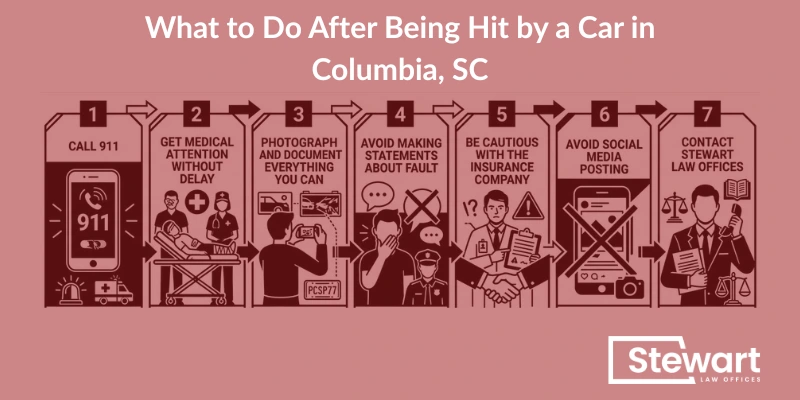
What to Do After Being Hit by a Car in Columbia
The actions you take in the immediate aftermath of a pedestrian accident have a direct bearing on your ability to recover fair compensation:
- Call 911: Even if your injuries do not seem severe at the time, call for emergency services. A police report creates an official record of the crash that is foundational to any insurance claim or lawsuit.
- Get Medical Attention Without Delay: Pedestrian accident injuries are frequently more serious than they appear immediately after impact. Internal injuries, brain trauma, and spinal damage can present subtly at first and worsen rapidly. See a physician as soon as possible, and make sure the connection to the accident is documented in your medical records.
- Photograph and Document Everything You Can: If you are physically able, photograph the vehicle, the driver’s license plate and insurance information, the road conditions, the crash location, crosswalk and signal status, and your visible injuries. Bystander contact information is valuable; ask for it before people leave the scene.
- Avoid Making Statements About Fault: Do not tell the driver or police that you were not paying attention, that you did not see the vehicle, or anything that could be characterized as an admission. Stick to the facts of what happened.
- Be Cautious With the Insurance Company: The at-fault driver’s insurer will contact you. They may be friendly, but their goal is to minimize their costs. Do not give a recorded statement and do not accept any settlement offer before speaking with an attorney who can evaluate whether it reflects the full value of your claim.
- Avoid Social Media Posting: Do not post about the accident or your recovery on social media. Insurance adjusters monitor claimants’ profiles and use posts to dispute injury severity. Even an innocent photo or comment about feeling better can be used against your claim.
- Contact Stewart Law Offices: The sooner our attorneys are involved, the better positioned we are to preserve evidence, identify witnesses, and build the strongest possible foundation for your claim.
How Our Columbia Pedestrian Accident Lawyers Approach Your Case
At Stewart Law Offices, we treat every pedestrian accident case as a complete legal investigation. Our attorneys and legal team will:
- Gather and Analyze Evidence: We will obtain and meticulously analyze the police report, witness statements, traffic camera footage, and any relevant surveillance video from nearby businesses.
- Investigate Liability Factors: We thoroughly investigate whether driver factors like impairment, distraction, or speeding contributed to the crash, ensuring these factors are documented for the record.
- Identify All Responsible Parties: We work to identify every potentially liable party. This includes the driver, their employer if they were on the job, or a government entity if infrastructure failures played a role.
- Document the Full Scope of Damages: As needed, we partner with medical specialists, life care planners, and economists to fully document all past and future damages you have incurred.
- Manage Communication and Negotiation: We handle all communication and negotiation with the insurance company, protecting you from pressure to accept a settlement that is too low or premature.
- Prepare for Trial: Every case is prepared as if it will be presented to a Richland County jury. This rigorous level of preparation consistently leads to better outcomes, whether the case is resolved through settlement or proceeds to trial.
Visit Our Columbia Pedestrian Accident Lawyers
Contact a Columbia Pedestrian Accident Lawyer Today
If you were struck by a vehicle while walking anywhere in Columbia or Richland County, on a busy commercial road, in a residential neighborhood, near a campus, or anywhere else in the area, Stewart Law Offices is ready to hear your story and fight for the compensation you deserve.
We handle pedestrian accident cases on a contingency fee basis. You pay no attorney fees unless and until we recover for you. Call us at (803) 743-4200 or contact us online to schedule your free case evaluation. If your injuries prevent you from coming to us, we will find a way to come to you.
Frequently Asked Questions About Columbia Pedestrian Accident Claims
The fundamental legal principles are the same, such as negligence, comparative fault, and available damages, but pedestrian accident claims often involve more complex fault disputes because insurance companies regularly try to argue that pedestrians contributed to their own injuries. Crossing outside a marked crosswalk, wearing dark clothing at night, or stepping off a curb without looking can all be raised as comparative fault arguments. The practical difference is that the injuries in pedestrian accidents tend to be far more severe, the damages far larger, and the scrutiny from the insurance defense correspondingly more aggressive. An attorney who specifically handles pedestrian cases in Columbia understands how these claims are typically contested and what evidence is needed to defeat fault-shifting arguments.
Crossing outside a designated crosswalk constitutes jaywalking under South Carolina law, and the defense will certainly raise it. However, it does not automatically bar your recovery. Under South Carolina’s modified comparative fault system, the question becomes what percentage of fault each party bears. A driver who was speeding, distracted, or impaired still bears significant responsibility for striking a pedestrian they could reasonably have seen and avoided, even one crossing outside a crosswalk. If your assigned fault percentage remains at or below 50 percent, you can still recover compensation, though your award will be reduced proportionally. An attorney can evaluate the specific circumstances of your crash and advise you on how this argument is likely to play out.
Not necessarily. South Carolina requires auto insurers to offer uninsured motorist (UM) coverage, and in a hit-and-run situation, where the at-fault driver is unknown, your own UM coverage may apply. As a pedestrian, you are typically not required to have your own auto insurance to access UM benefits; the coverage may be available through a family member’s policy if you are a household resident, or through the vehicle registration of a household member. There are specific procedural requirements, including prompt reporting to law enforcement and your insurer, that must be satisfied. Contact an attorney as quickly as possible after any hit-and-run pedestrian accident to protect your ability to access these potential benefits.
South Carolina’s standard statute of limitations for personal injury claims is three years from the date of the accident. For wrongful death claims, it is three years from the date of death. Missing this deadline, with narrow exceptions, means permanently losing your right to file suit and seek compensation in court, regardless of how clearly the driver was at fault. The exceptions include claims against government entities (which have shorter deadlines), claims involving injured minors (the limitations period typically does not run until they turn 18), and, in rare circumstances, where the discovery rule may apply. Given that evidence deteriorates, witnesses’ recollections fade, and critical documentation becomes harder to obtain over time, consulting an attorney well before any deadline is always the wisest course.
This is one of the most common and most stressful practical concerns our clients raise. Several options may be available. Your own health insurance covers treatment regardless of how the injury occurred, though there may be a right of reimbursement (subrogation) from any eventual settlement. If you have MedPay coverage on an automobile policy in the household, it may cover some medical expenses without waiting for the liability claim to resolve. Many medical providers who treat accident victims will agree to treat on a “lien” basis, deferring payment until a settlement is reached and taking payment from the proceeds. An experienced attorney can help you handle these options, manage provider relationships, and ensure that your access to necessary care is not cut short while the legal process unfolds.